
Jan 04, 2026
-
By Clive
The era of the “ghost seat” is over.
As CFOs audit 2026 budgets, they’re no longer hunting only for cheaper invoices. They’re looking to eliminate something far more expensive: the Toggle Tax.
Every time an employee jumps between a project board, a chat thread, and a document, your company loses minutes. Those minutes quietly compound into weeks—and eventually months—of wasted salary and lost momentum.
And in a market where 3 out of 4 CEOs believe the company with the most advanced generative AI will win, it raises an uncomfortable question:
Why are you still paying for a fragmented software stack that actively slows your teams down?
(IBM CEO Study)
A realistic 30% reduction in SaaS spend doesn’t come from aggressive vendor negotiations. It comes from fixing structural waste.
There are three primary levers:
License optimization – removing ghost seats
Tool consolidation – eliminating overlapping platforms
Pricing model correction – avoiding AI add-ons and unfair seat minimums
The real win isn’t just smaller invoices. It’s fewer tools, faster execution, and dramatically less operational drag.
Most organizations lose money in the same predictable places.
| Cost Leak | What It Looks Like | How It Creates Waste | The Fix |
|---|---|---|---|
| Ghost seats | Paid users who aren’t active | Renewals include dormant accounts | Usage-based audits + deprovisioning |
| Redundant tools | Slack + Notion + Monday + extras | Paying multiple times for the same workflow | Consolidate into one WorkOS |
| AI add-on tax | AI priced separately per user | You pay twice: tool + AI layer | Choose native AI |
| Tool sprawl | Too many apps across teams | Security, onboarding, admin overhead | Standardize and reduce |
| Search & context loss | Time spent hunting information | Teams rebuild what already exists | Enterprise search across work |
If you want a reality check: Okta’s Businesses at Work report shows most companies now run dozens to over 100 apps—and the number keeps growing. Sprawl is the default unless you design against it.
Here's how you can implement the 4-step framework for SaaS Cost Reduction:
Ghost seats are the fastest savings win.
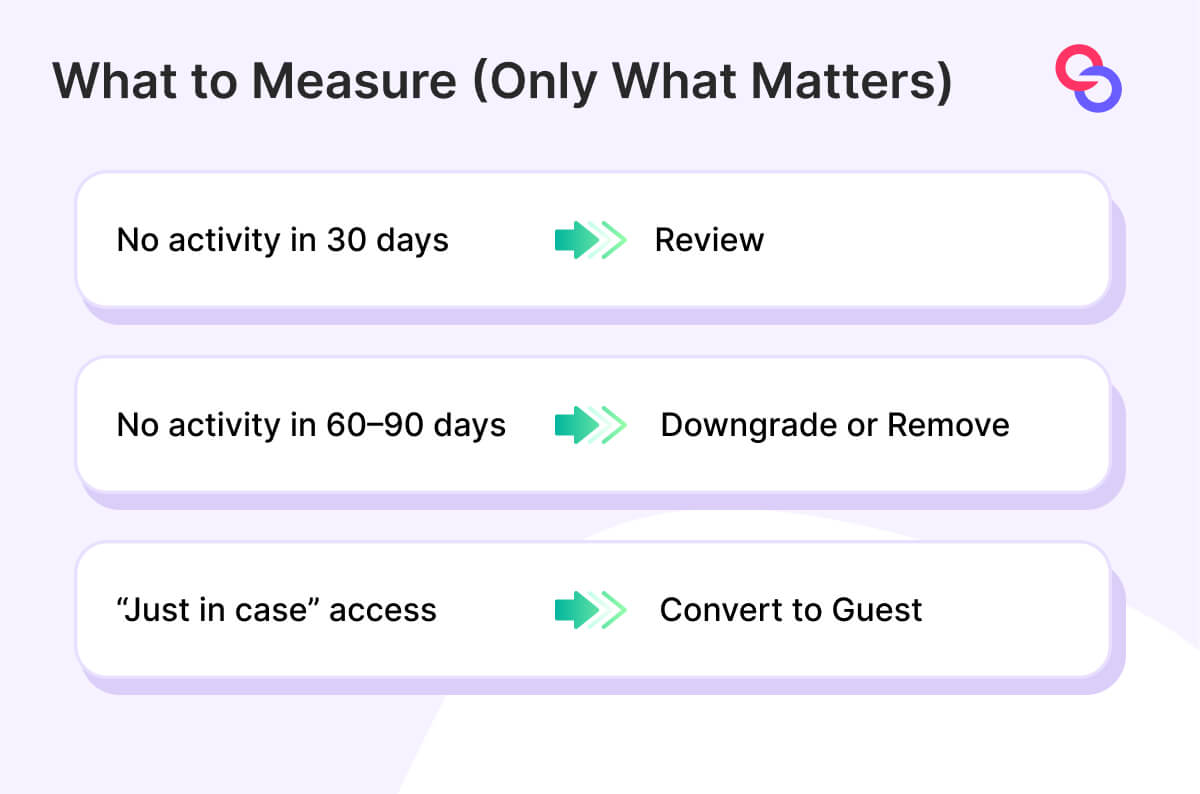
Run a 30-day license utilization audit before renewal using simple activity data. Most organizations discover a surprising number of paid seats are inactive due to role changes, contractors, churn, or duplicated access.
What to Measure (Only What Matters)
Multiple industry analyses consistently show that unused/underutilized software is a major waste category—often around “half the licenses” in large environments depending on measurement methodology. (Nexthink findings; CFO Dive coverage of SaaS waste)
Preventing Re-Bloat: The Offboarding Workflow
Ghost seats return when offboarding is sloppy. A simple workflow fixes this:
HRIS termination triggers IT action
Access removed within 24 hours
License reclaimed within 72 hours
Seat returns to a license pool (not auto-reassigned)
This alone often delivers savings in the very next renewal cycle.
The fastest path to 30% savings is consolidation.
If you’re paying for Slack + Notion + Monday/ClickUp, you’re funding the same workflow three times—plus paying the coordination tax between them.
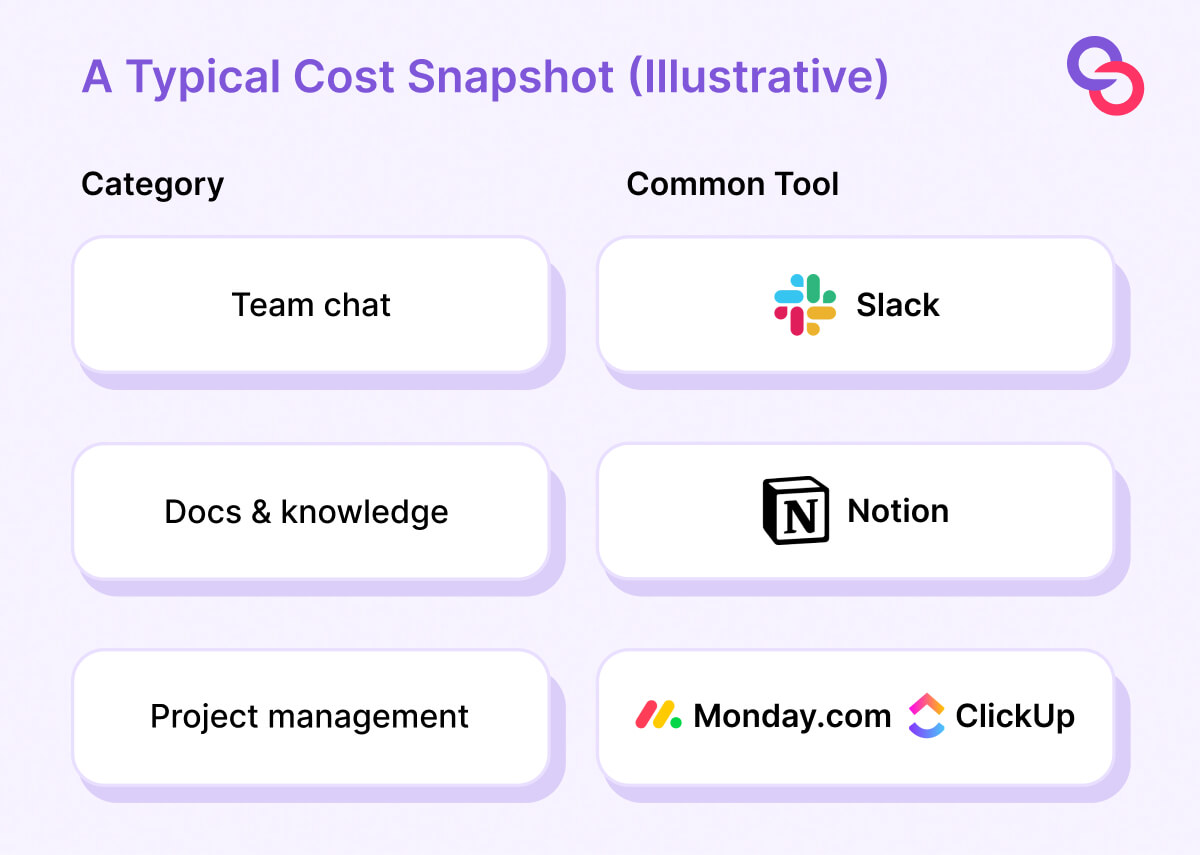
Now layer in the hidden costs:
Separate admins and permissions
Separate onboarding and training
Data split across systems
Constant context switching
Kroolo isn’t a bundle of stitched-together tools. It’s an AI-native WorkOS where search, projects, docs, and chat operate as one system—so context never breaks.
1. Kroolo Enterprise Search (ES): Search Once. Find Everything.
Traditional workplace search returns documents. Kroolo delivers answers.
It understands intent, context, and relationships—so employees don’t need to remember where information lives.

One search bar across work, docs, and conversations
Semantic AI that understands meaning, not keywords
Trusted answers instead of document dumps
Enterprise Search becomes a control system—not a time sink.
2. Kroolo Projects: From Brief to Board in Seconds
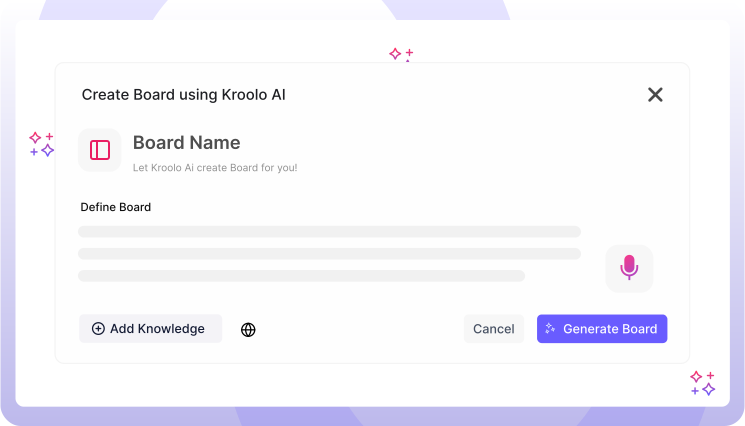
Kroolo Projects lets teams create fully structured project boards using AI.
Upload a brief, RFP, or requirements doc. Use a text or voice prompt. Kroolo automatically generates tasks, subtasks, owners, and structure—removing hours of manual setup and ensuring nothing critical is missed.
Work starts faster, and planning friction disappears.
3. Kroolo Docs: Knowledge That Works for You
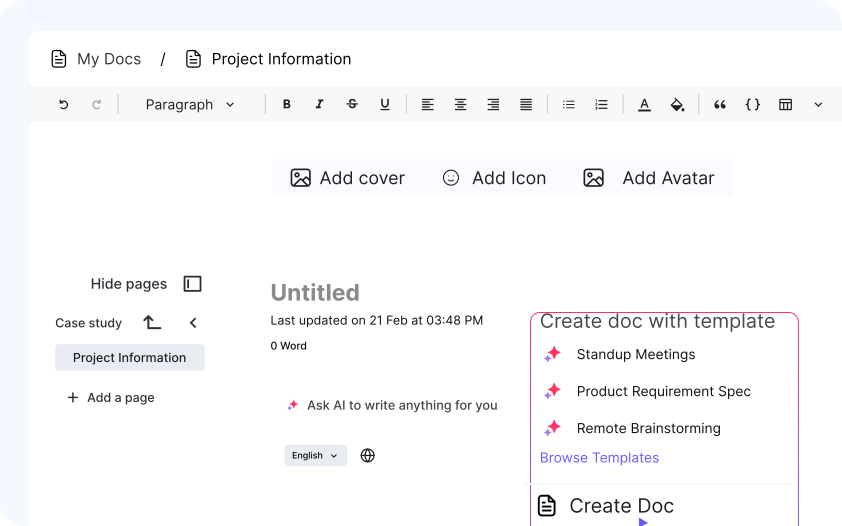
Documentation shouldn’t slow teams down.
Kroolo Docs uses AI to create, refine, and maintain documentation with consistency across projects. Teams can also chat directly with documents—PDFs, decks, and files—to extract insights instantly.
Instead of reading through pages, users ask questions and get answers in seconds.
4. Kroolo Chats: Conversations That Don’t Lose Context
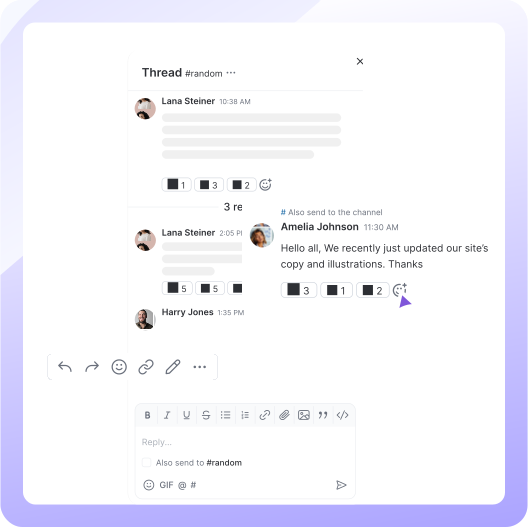
Most chat tools lose decisions in threads.
Kroolo Chats keeps conversations attached to the work itself—projects and documents—so teams never have to repeat explanations or hunt for links.
Direct messages, group chats, channels, and threads all retain context automatically.
AI should be treated like electricity—native and always on, not a metered luxury.
AI add-ons inflate per-seat costs and fragment workflows, forcing teams to use one tool for work and another for “AI help.”
AI priced per user as an add-on
Usage credits that force upgrades
AI locked behind higher tiers
The executive lens: If AI is key to competitive advantage, it cannot be a bolt-on. IBM’s CEO research ties competitive advantage to advanced GenAI adoption. (IBM CEO study).
Kroolo’s model: AI is part of the platform—not an upsell.
Reducing SaaS spend isn’t only about removing tools—it’s about removing the need for those tools by eliminating time loss from context switching, slow retrieval, and duplicated work. The best “budget cut” is making the stack so unified that teams don’t ask for another app.
When information is hard to find, teams respond by buying new tools, recreating documents, duplicating projects, and spinning up shadow systems.
Research on interruption and task resumption consistently shows significant focus recovery costs—switching contexts is not free. (Microsoft Research citing ~23-minute resumption time)
And McKinsey’s research on collaboration technologies highlights large productivity opportunities in knowledge work and internal collaboration.
Example: the “ClickUp → Kroolo” consolidation move (cost + velocity)
Consider a marketing team running:
Before: Every campaign involves searching old docs, chasing context in chat, and rebuilding boards manually.
After (Kroolo):
Use AI project generation to build a campaign board from a brief, ask for summary, set up automation or manage risk and workload.
Use AI Powered Enterprise Search to retrieve prior campaign insights across docs + chat + tasks.
Keep decisions, execution, and documentation in one system so the “where is that?” question disappears.
This is how spend reduction becomes a Productivity Renaissance—less software, more throughput.
Ready to stop paying for ghost seats? Book a 5-minute demo to see how Kroolo can migrate your workspace and cut software spend fast.
If you want 30% savings without chaos, you need a controlled migration path: cut waste first, then consolidate, then lock governance so bloat doesn’t return.
Output: one-page “Stack Map” your CFO can understand.
Target outcome: 10–15% savings quickly from top vendors alone.
Your biggest overlaps usually sit here:
Pilot consolidation with one team (e.g., Marketing or Ops):
Turn on unified retrieval and usage norms:
Output: a stack that naturally resists sprawl.
Reducing SaaS spend by 30% requires consolidating fragmented tools (project management, documentation, communication) into unified platforms, eliminating seat minimums, and choosing native AI solutions over legacy tools with expensive add-ons. This approach cuts costs while increasing team velocity.
Traditional cost-cutting focuses on negotiating better deals with existing vendors. That's a losing strategy. Here's why the new playbook centers on architectural consolidation rather than incremental discounts:
Map every tool against these three core functions:
Most organizations pay separately for each category, often with redundant features. A typical mid-market setup looks like this:
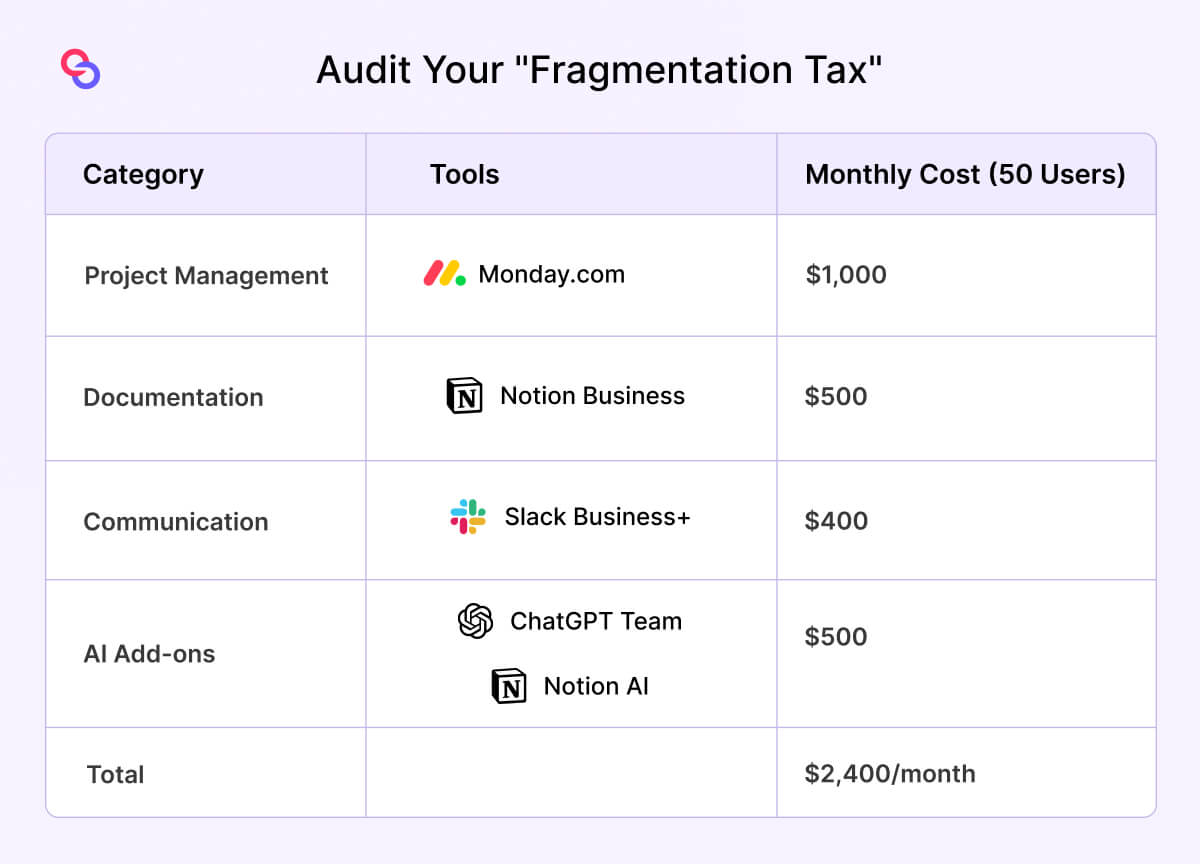
That's $28,800 annually—before accounting for integration costs, admin overhead, and the productivity drain of switching between these systems.
Forrester research demonstrates that software TCO extends far beyond subscription fees:
When you factor in these hidden costs, that $28,800 stack actually costs closer to $45,000 annually.
AI-native platforms unify project management, documentation, and communication into single systems with built-in intelligence.
Unlike legacy "AI-enabled" tools that add chatbots to old architectures, AI-native solutions eliminate app-switching entirely, reducing costs by 30-50% while accelerating workflows through contextual automation.
The shift from "AI-enabled" to "AI-native" isn't semantic—it's architectural. Legacy platforms like Slack and Notion are bolting AI onto decade-old codebases. AI-native platforms like Kroolo rebuild the entire work experience around intelligent interaction layers.
Legacy "AI-Enabled" Approach:
AI-Native Architecture:

Consider a 15-person marketing team currently using:
Current State:
After Consolidating to an AI-Native WorkOS:
Savings: $2,340 annually (34%) plus 4+ hours per employee weekly reclaimed from elimination of Toggle Tax.
Conclusion
Cutting SaaS spend by 30% isn’t about being “lean.”
It’s about being fast. In 2026, the advantage belongs to organizations that stop funding fragmentation and start funding a unified, AI-native operating layer. Eliminate ghost seats, collapse redundant categories, remove AI add-on taxes, and kill the Toggle Tax. Then your software budget stops being a leak—and becomes leverage.
If you want to see what consolidation looks like in practice, sign up with Kroolo and pressure-test your current stack against a unified WorkOS.