
Jan 11, 2026
-
By Clive
Sprint planning was never meant to be a full-time job.
Yet for most engineering teams, it has quietly become one. Every sprint begins with the same ritual: two-hour backlog grooming sessions, manual ticket breakdowns, estimation meetings, and configuring boards that are already outdated by Week 2.
This friction doesn’t just feel slow — it is slow. Industry research shows that coding itself accounted for only 16 % of a developer’s working time in 2024, with the majority of hours consumed by operational and background tasks like requirements, testing, CI/CD, monitoring, and planning.
If your senior engineers are spending Monday mornings copy-pasting requirements into a legacy tool, this isn’t process maturity — it’s expensive manual labor.
In 2026, the best sprint isn’t the one you plan in meticulous detail. It’s the one that builds itself.
The real bottleneck isn’t lack of discipline or talent. It’s that most teams are still using tools built for a pre-AI era — tools that require humans to repeatedly translate product intent into tasks, losing context with every handoff.
This is why AI-native sprint planning isn’t a feature upgrade. It’s a structural shift in how teams move from knowing what to build to actually building it.
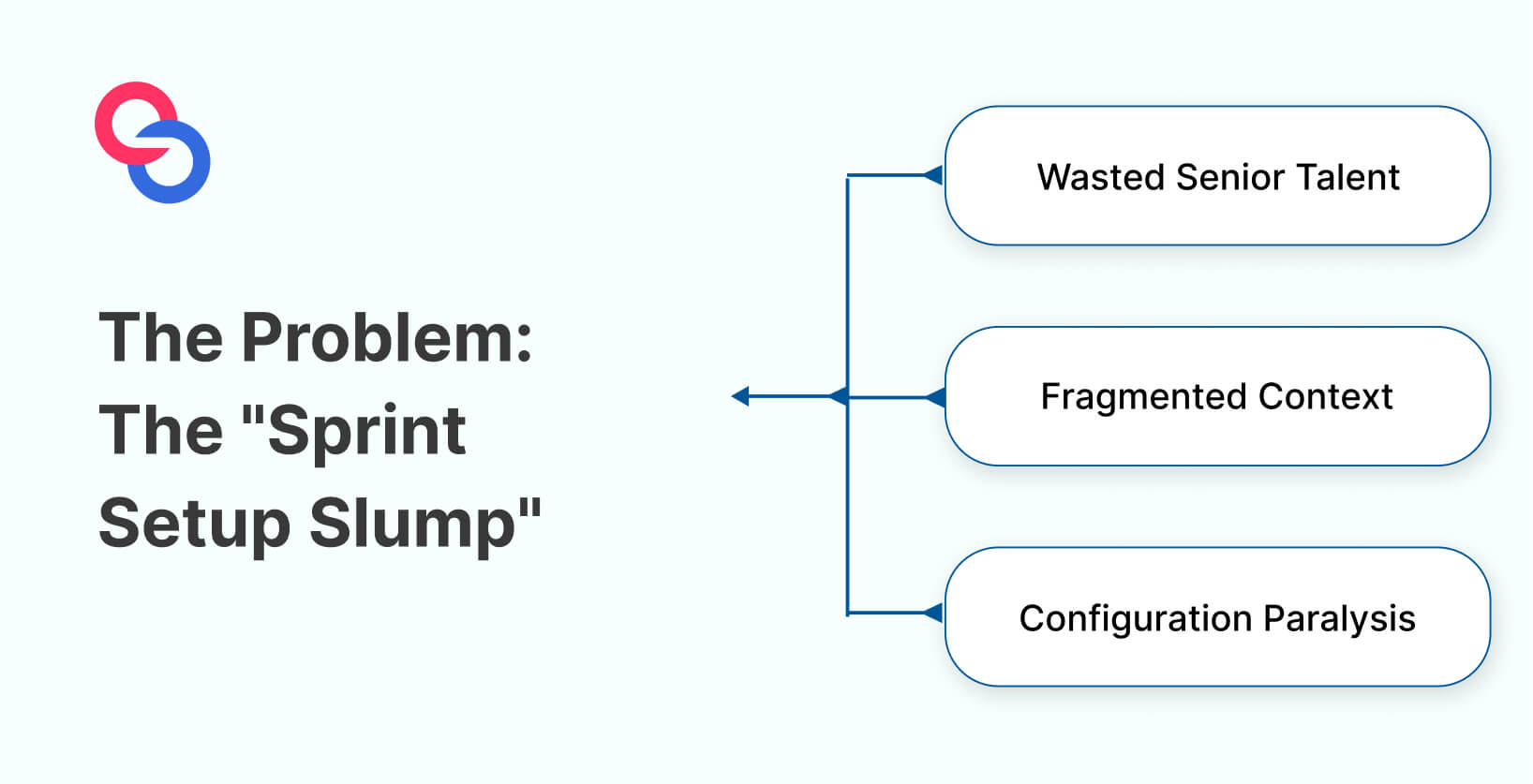
Manual sprint planning has become a major bottleneck for engineering velocity. It’s a "translation gap" where high-level product specs are slowly, manually broken down into actionable tasks.
For most teams, this looks like:
When your team spends hours grooming backlogs and manually building boards, you aren't just losing time—you're losing focus. In a high-velocity environment, human error in setup leads to technical debt and delayed kick-offs before the first line of code is even written.
For technical leaders, "Time to Sprint" is a critical metric. It measures the gap between receiving a requirement and the moment a developer actually starts coding.
In a competitive market, this gap is where agility goes to die. Here is why reducing that window is vital:
Reducing your planning-to-execution window isn't just about speed—it’s about giving your team the space to do the high-level work they were actually hired to do.
Sprint planning doesn’t need to be optimized. It needs to be eliminated as a manual task.
Instead of asking engineers to translate requirements into tickets, modern teams let AI do the translation. This is where AI prompts replace backlog grooming, board setup, and repetitive planning work.
With AI-driven sprint planning, teams describe what they want to build, not how to configure a tool.
A sprint can start from:
Using a single prompt, AI converts intent into execution. Tasks are created, broken down, prioritized, and structured automatically. Dependencies are identified early, and work is organized into a ready-to-run sprint board.
This removes the biggest source of planning friction: manual setup. AI prompts close the translation gap by directly converting product context into actionable engineering tasks. No copy-pasting. No re-writing. No re-explaining work across tools.
Sprint planning becomes an automated outcome, not a recurring meeting. This is the shift from planning-heavy workflows to execution-first engineering — where teams spend their time building, not configuring.

Kroolo turns sprint planning from a manual, time-consuming task into an automated, intelligence-driven workflow. With Kroolo, planning is no longer about filling out boards — it’s about telling AI what you want to achieve and letting it handle the execution details.
Here’s how it works:
Start by going to Projects and selecting “Create Project Using AI.” Add the project name, upload your knowledge base, PDFs, DOCs, or any relevant files, and set the project timeline. Kroolo uses this content as the foundation for your sprint.
This is the first step in Prompt-to-Project™: by providing high-level inputs, you’re prompting Kroolo to generate an entire project structure automatically, including tasks, milestones, dependencies, and priorities.
Once your project is created, Kroolo’s AI parses your uploaded content and breaks it down into technical, executable tasks. Features, subtasks, and dependencies are automatically identified. Each task is enriched with context — linking back to relevant documentation, specifications, or discussion threads — so engineers never lose time hunting for information.
This is the core of AI Task Planning: you don’t just ask Kroolo to “make tasks.” You can prompt it with statements like:
Kroolo converts your natural-language prompt into a structured sprint board instantly. Your team goes from “brief received” to “sprint ready” in minutes, not days.
With the sprint board in place, Kroolo’s AI Agents automate ongoing project management:
This allows engineering leaders to focus on strategy and execution, not administrative overhead.
All tasks generated by Kroolo are context-aware. Every task carries references to original PRDs, notes, or technical documents. Conversations, decisions, and documentation are linked automatically, so developers never lose context when moving from planning to coding.
With Kroolo, sprint planning becomes a single, prompt-driven workflow:
No manual setup. No copy-pasting. No fragmented context. Just speed, precision, and uninterrupted developer focus.
Scenario: A Solo Consultant Replacing a Legacy Planning Tool
A solo technical consultant manages multiple short-term client projects. To unlock basic automation features on a legacy project management platform, they are forced into a 3-seat minimum plan costing $36 per month, despite using only one seat.
Sprint planning is still manual. Client briefs arrive as PDFs or Docs. Tasks are created by hand. Context is copied into tickets. Automation exists, but only after time-consuming configuration.
The Problem
The Kroolo Switch
The consultant moves to Kroolo, which has no seat minimums and native AI built into the core workflow.
They go to Projects → Create Project Using AI, upload the client brief (PDF/DOC), add project dates, and enter a single prompt:
Prompt used:
“Create a 2-week sprint plan from this client brief. Break the work into clear tasks and sub-tasks, set priorities, and organize everything into a sprint board.”
Within seconds, Kroolo’s Prompt-to-Project™ engine parses the document and generates a complete project structure.
Using AI Task Planning, the consultant can then ask follow-up prompts like:
Kroolo’s AI Agents handle task updates, workload tracking, and reporting automatically—without any additional setup.
The Outcome
The Takeaway
One prompt replaces hours of manual planning. What used to require multiple tools, seats, and setup steps now happens automatically inside a single AI-Native WorkOS.
That’s the power of Prompt-to-Project and AI Task Planning—and why manual sprint planning is no longer defensible, even at the smallest scale.
Conclusion
Manual sprint planning is outdated. It worked when teams were smaller and tools were only used to track tasks. Today, it wastes time and pulls engineers away from real work.
AI-native teams don’t spend hours setting up boards or turning documents into tickets. They let AI do that work.
With Prompt-to-Project, a sprint starts with one prompt.
With AI Task Planning, tasks are created, prioritized, and linked to context automatically.
With AI Agents, standups, workload tracking, reports, and risks are handled in the background.
This isn’t about adding AI to old tools. It’s about using an AI-Native WorkOS built for execution.
The future isn’t better sprint planning. It’s no manual sprint planning at all.
Don’t let outdated workflows slow your team down. Sign up for free and automate your first sprint today.