
Jan 12, 2026
-
By Ivan
“Stop searching for files and start finding answers.”
If you’ve ever spent ten minutes digging through Slack threads, another ten hunting for a PDF in Google Drive, and then scrolling Jira for the matching ticket, you’ve experienced the modern workplace paradox: the information exists, but it may as well be invisible.
In 2026, the problem isn’t knowledge scarcity — it’s knowledge fragmentation.
The average employee switches between 10+ apps per day just to answer a single question.
Multiply that by hundreds of employees and thousands of daily queries, and you get a silent productivity drain that costs organizations millions annually.
The real question isn’t “Where is the file?”
It’s “Why do I need five different apps to find one answer?”
Unified search is no longer optional. It’s the engine of modern execution.
Organizations lose an average of 19.8% of productive time to information searching and retrieval, with employees switching between 10+ applications daily to access fragmented company knowledge across disconnected platforms like Slack, Google Drive, Jira, and Notion.
The modern enterprise runs on scattered knowledge silos. Your team's collective intelligence is trapped:
According to IDC research, knowledge workers spend 2.5 hours per day searching for information, and 44% of the time they don't find what they're looking for.
McKinsey reports that employees spend nearly 20% of their workweek searching for internal information or tracking down colleagues who can help with specific tasks.
For a 50-person team:
But the financial calculation doesn't capture the complete damage:
Asana's Anatomy of Work Index found that workers switch between apps 10 times per hour on average. Each context switch carries a 23-minute recovery period before returning to peak cognitive performance.
The mathematics are brutal: your team isn't just searching—they're spending the majority of their day in a state of fractured attention.
Unified search drastically reduces Information Discovery Time by aggregating all company knowledge into a single interface.
Instead of searching each app manually, employees can retrieve insights instantly, improving project delivery speed, support resolution times, and cross-team collaboration.
For a CXO or Operations Manager, "Information Discovery Time" is a direct drain on profitability. Research from McKinsey suggests that knowledge workers still spend about 19% of their workweek searching for and gathering information.
In an AI-driven market, being able to access organizational insights instantly is no longer a luxury—it is a competitive advantage.
|
|
|
|
|
|
|
|
|
|
|
|
|
|
|
|
|
|
|
|
By improving your team’s Knowledge Velocity, you don't just find files faster; you empower your Support Engineers and Operations teams to provide accurate answers to clients in real-time, drastically reducing churn and increasing satisfaction.
AI transforms search by using semantic understanding—interpreting the meaning behind your query. Instead of relying on exact keywords, AI analyzes context across chats, documents, and tickets to deliver precise answers.
This allows employees to ask conversational questions and receive complete, cross-referenced insights instantly.
Traditional search = keyword-based → incomplete results
AI search = context-based → comprehensive answers
With semantic search, you can ask:
“What was decided about API throttling last quarter?”
“Show all discussions about the billing outage.”
“Summarize onboarding issues from Zendesk + Slack.”
And AI gathers information from all connected sources, surfacing results with citations.
This eliminates 👇
One question → One answer → Zero switching.

Most enterprise search tools fail for one simple reason: they treat search as a destination. Kroolo treats it as a daily workflow.
Instead of forcing teams to decide where to look—Slack, Drive, Jira, Notion, or email—Kroolo gives them a single place to ask questions, explore knowledge, and take action: Kroolo Enterprise Search (ES).
You can ask, write, or search for anything.
Behind the scenes, Kroolo uses AI-powered semantic understanding. It doesn’t just match keywords—it understands intent, meaning, and context.
So instead of searching for exact phrases, Kroolo interprets what you’re really asking, scans connected tools in real time, and returns clear, contextual answers with citations.
Teams don’t just get results—they get answers they can trust.
In most organizations, even when someone finds the right answer, it disappears the moment the browser tab closes. Kroolo changes that.
With Collections, teams can capture and organize insights as they work. Related documents, conversations, decisions, and AI-generated answers can be grouped into curated knowledge hubs that stay useful long after the original question was asked.
Over time, this creates a living knowledge base—without asking teams to document everything manually.
What starts as a search becomes reusable organizational memory.
What truly separates Kroolo from traditional enterprise search tools is its use of AI Agents.
Kroolo comes with nine default AI agents, each designed around real workplace roles—such as Product Manager, Engineering Manager, Project Manager, QA Analyst, Sales Manager, and more.
These agents don’t just retrieve information. They analyze it, summarize it, and act on it.
For example:
Teams can also create and share custom agents, extending Kroolo’s intelligence across departments.
Instead of knowledge sitting idle, agents continuously turn information into insights—without manual follow-ups or status meetings.
Kroolo brings search, chat, tasks, and intelligence into a single system.
Results stay accurate thanks to real-time synchronization, and access is protected with enterprise-grade security, including RBAC and permission controls. Employees see only what they’re allowed to see—nothing more, nothing less.
And because Kroolo is also a work platform, teams can act immediately:
This is how Kroolo reduces internal service requests by up to 50% and cuts time spent searching in half.
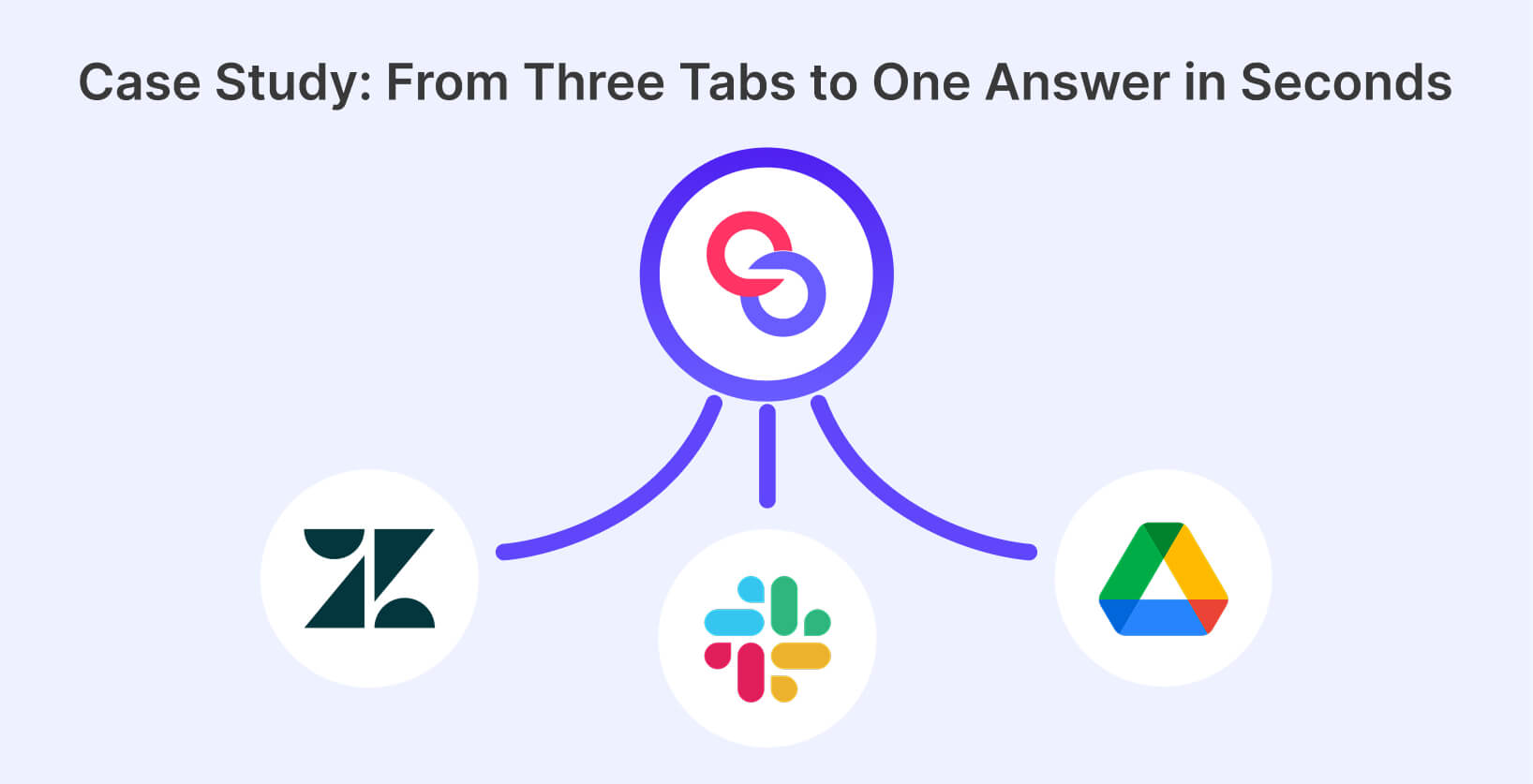
A Support Engineer was tasked with diagnosing a recurring Bluetooth connectivity issue reported by multiple customers. The required information already existed—but it was scattered across systems:
To understand whether this issue had been seen before, the engineer had to manually search each system, cross-reference findings, and mentally stitch the context together. This process was slow, error-prone, and disruptive. Investigating a single issue could take 30–45 minutes, delaying resolution and increasing customer frustration.
Instead of opening multiple tools, the engineer used Kroolo's Enterprise Search.
They asked one question:
“Summarize all Zendesk tickets, Slack discussions, and documents related to Bluetooth issues.”
Kroolo’s AI instantly searched across Zendesk, Slack, and Google Drive, understanding context rather than just keywords.
Within seconds of asking the question, Kroolo returned a single, coherent answer.
Instead of scattered snippets, the Support Engineer received a clear summary of all past Bluetooth-related issues, combining insights from Zendesk tickets, Slack discussions, and technical documents stored in Google Drive.
The AI highlighted recurring patterns and likely root causes, surfaced relevant Slack conversations where decisions were made, and linked directly to the exact tickets and specifications used to generate the response.
Every insight came with accurate citations, so the engineer could instantly verify sources and trust the information without second-guessing.
There was no need to open multiple tabs, retrace conversations, or wonder if something had been missed.
No tab switching. No guessing. No lost context.
The engineer could move immediately from investigation to action—resolving the issue faster and improving customer satisfaction.
This case highlights a broader problem modern teams face: knowledge exists, but it’s fragmented.
Kroolo eliminates that fragmentation by turning scattered tools into a single, intelligent source of truth. Teams stop searching for information and start using it.
When support teams can ask one question and get one trusted answer—complete with citations—productivity compounds and response quality improves. That’s the power of unified, AI-native work.
Conclusion
Stop the endless search and start moving at the speed of thought.
The organizations winning in 2026 aren't the ones with the most information—they're the ones who can access their information fastest, synthesize it intelligently, and act on it decisively.
Join the companies already finding answers 75% faster with:
Sign up for Kroolo free and connect your first app to experience the power of unified search today. Your team's collective intelligence is already there. We just make it reachable