
Mar 27, 2026
-
By Clive
If your team is still toggling between five apps to get one task done, you’re not managing work. You’re managing friction.
By 2026, remote teams won’t struggle because of talent gaps or unclear strategy. They’re struggling because their systems were never built for how work actually happens today.
Slack for communication. Notion for docs. Monday for projects. Google Drive for files.
Individually powerful. Collectively broken.
This is the Productivity Paradox: the more tools you adopt to move faster, the slower your organization becomes.
For CTOs, Heads of Product, and Operations leaders, tool fragmentation isn’t just inconvenient—it’s expensive.
In fact, research shows knowledge workers spend up to 2.5 hours per day just searching for information across tools
This is what we call Siloed Intelligence—when your organization has the data, but not the ability to use it in real time.
In an efficiency-first market, this is not sustainable. Because speed is no longer about effort. It’s about architecture.
Most work platforms today were built in a pre-AI era.
They’ve tried to adapt—adding AI assistants, copilots, and sidebars—but the core architecture remains unchanged.
The result? AI that helps you write faster—but not work smarter.
And for remote teams operating across time zones, this gap is critical.
Fragmentation doesn’t just slow teams down—it kills focus.
Knowledge workers lose up to 40% of their productivity due to constant context switching. Moreover, it can take 20+ minutes to refocus after a single interruption
This is the invisible tax on every remote team. Not effort. Not talent. Just friction.
2026 marks a fundamental shift: From tools that organize work → to systems that execute work.
This is where AI-Native WorkOS comes in.
Instead of stitching together multiple apps, an AI-native system is built around a single principle:
Work should feel less like searching—and more like thinking.
Kroolo isn’t built for the old way of working. It’s built for what’s next.
Welcome to the Age of Consolidation—where speed doesn’t come from adding more tools, but from eliminating them.
Kroolo is not another layer in your stack. It is the system that replaces it.
At the core of Kroolo is a unified architecture designed around how work actually happens—not how software was traditionally built.
Three layers. One system. Fully AI-native.

Let’s be honest—project management today is a lot of manual work.
You create tasks.
You assign people.
You keep asking for updates.
You try to figure out where things stand.
Kroolo changes that with a complete Project Management.
You just describe what you want—type it, speak it, or upload a brief—and Kroolo builds the entire project for you. Tasks, timelines, priorities, dependencies… all set up in seconds.
But it doesn’t stop there.
As work moves forward, Kroolo keeps things updated automatically. Tasks adjust, dashboards stay current, and everything—from sprints to budgets—lives in one place.
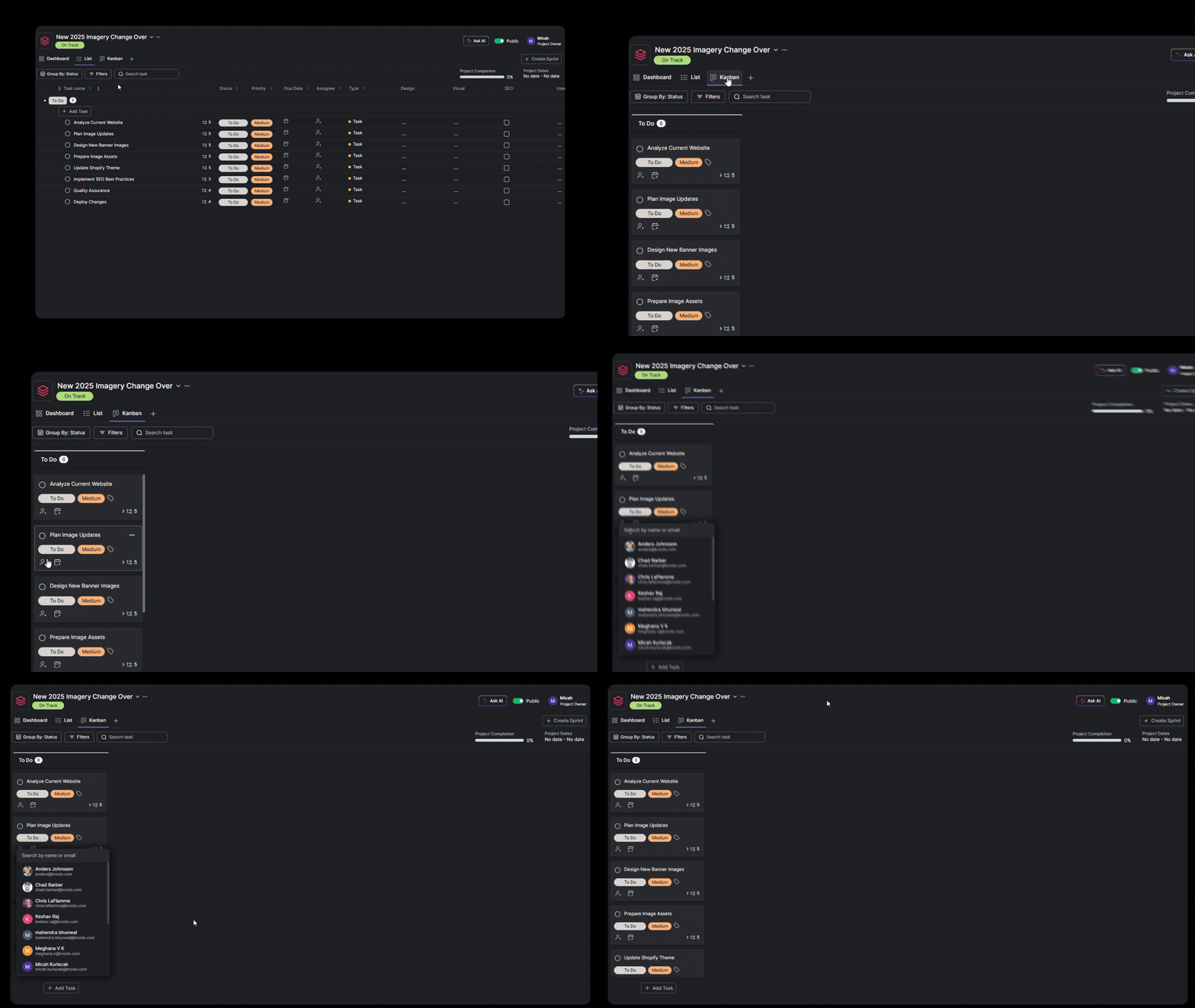
You can view your work however you like: Kanban, Gantt, Timeline, Calendar, or Table.
And when you need an update, you don’t go searching. You just ask.
Attach docs, turn chats into tasks, or simply chat with your project to get a quick summary.
At some point, you stop managing the project.
It just runs.
Most docs get written… saved… and then forgotten.
Kroolo makes them useful again.
Here, a doc isn’t just for storing information—it helps you take action.
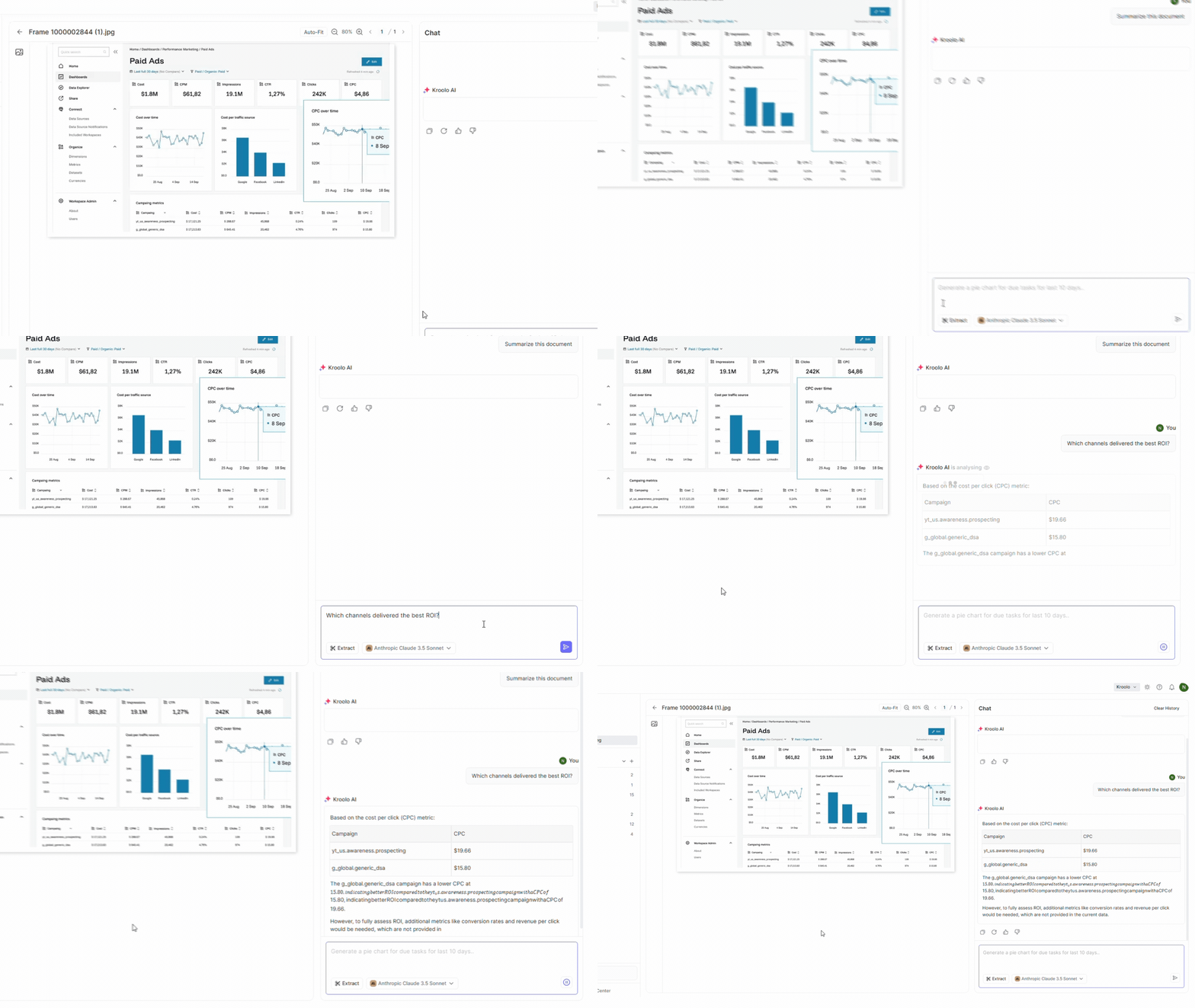
You can create content with AI, chat with a doc to get answers, or highlight anything and turn it into a task instantly. Docs are connected to your projects, so everything stays in sync.
They can even trigger automations. So instead of sitting there, they actually move work forward.
And if your team already uses Google Drive, Dropbox, or Confluence, you can bring everything in easily.
With real-time collaboration, version history, and simple folders, everything stays organized as your work grows.
The result?
Docs that don’t just store information— they help you get things done.
This is where most teams struggle.
Work is in one place. Conversations are in another.
So decisions get made in chat… then someone has to update tasks… and later, no one remembers what was decided.
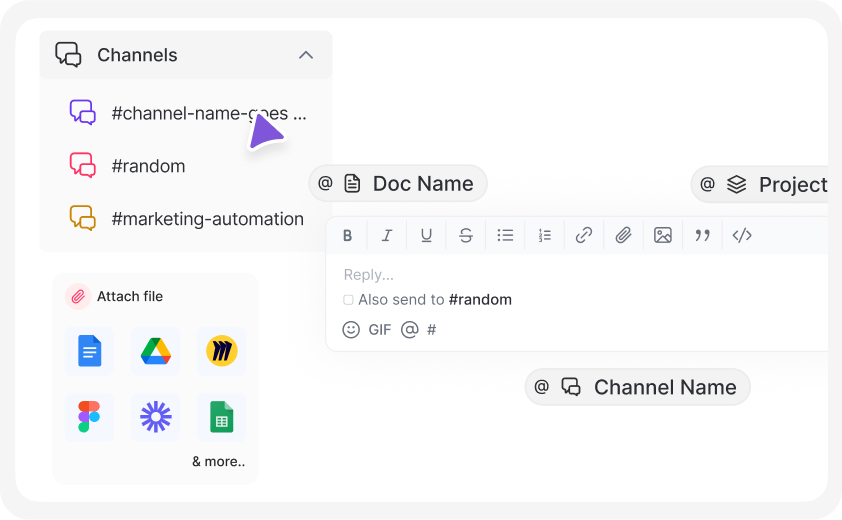
Conversations are directly connected to your work. Channels are linked to projects and docs, so everything has context. And messages aren’t just messages.
You can turn any message into a task. AI can summarize long conversations in seconds. Voice notes and threads keep things clear and easy to follow. Nothing gets lost. Nothing gets buried. So, when a decision is made, work moves forward immediately.
Docs, Projects, and Chat aren’t separate tools in Kroolo. They all work together as one system.
A doc creates context.
That context becomes action in a project.
And conversations keep everything moving.
No switching between apps.
No missing information.
No repeating work.
Just work that flows—simply and smoothly.
A remote engineering team decided to move away from ClickUp.
But migration usually comes with a cost:
What should be a fresh start often turns into days of manual setup and alignment.
With Kroolo, the team took a different approach.
They used the 1-click importer to move their entire workspace instantly—no manual effort, no loss of context.
Then, instead of rebuilding their roadmap, the team lead uploaded a technical spec PDF and simply said:
"Build a Q3 feature roadmap from this."
In seconds, Kroolo:
No setup. No back-and-forth.
What usually takes days… was done in seconds.
Instead of spending time setting up work, the team started executing it immediately. So, no rebuilding. no delays. Just a system that works the moment you do.
Conclusion
2026 won’t be won by teams with the most tools. It will be won by teams that move the fastest.
And speed doesn’t come from adding more software—it comes from removing friction.
That’s the shift Kroolo represents.
Instead of managing scattered tools, tabs, and workflows, you move to a system where everything is connected—where data turns into decisions, and decisions turn into action instantly.
Kroolo solves the fragmentation problem at its core. It brings your docs, projects, and conversations into one place—and layers intelligence on top of it.
So your team doesn’t just stay organized. It stays in motion.
If you’re still stitching together tools in 2026, you’re already behind.
Sign up for Kroolo and experience it yourself.