
Jan 07, 2026
-
By Julia
The hidden cost of your tech stack isn’t the subscription—it’s the 4 hours your team loses every week just switching tabs.
In 2026, the competitive divide is between teams that toggle and teams that flow. Are you still paying a “complexity tax” for tools that weren’t built to talk to each other?
Here’s the uncomfortable truth: most stacks weren’t designed—they accreted. A little Slack here, a little Notion there, Jira for engineering, Monday for ops, plus “just one more tool” for docs, approvals, wikis, and dashboards.
You don’t have a system. You have a patchwork. And the patchwork creates a dead zone where context dies, decisions stall, and execution becomes administrative toil.
This post breaks down the best 2026 playbook to eliminate toggle tax—architecturally, not cosmetically.
Toggle tax is the productivity loss caused by constantly switching between apps (docs, chat, tasks, dashboards) to complete one outcome.
Every switch forces reorientation, creates context loss, and increases errors. Over time, the organization pays a compounding tax in wasted salary, slower delivery, and fractured collaboration.
Toggle tax isn’t just “annoying.” It’s measurable cognitive overhead. When work is fragmented across systems, people spend time:
Research on interruptions and attention switching consistently shows there’s a real “switch cost” and reorientation overhead when people get pulled between contexts and tasks.
And in modern digital work, interruptions aren’t occasional—they’re constant. Microsoft’s Work Trend Index reporting (based on Microsoft 365 telemetry) describes how employees are interrupted extremely frequently during core work hours, making sustained focus rare.
The paradox: Your stack grows to increase productivity—but the stack itself becomes the work.
Toggle tax worsens in 2026 because SaaS sprawl keeps expanding while AI features are being “bolted on” to legacy tools that still store context in silos.
More apps mean more handoffs, more duplicate truth, more shadow workflows—and more time spent navigating systems instead of executing outcomes.
By 2026, most organizations aren’t dealing with a “tool problem.” They’re dealing with an architecture problem.
Okta’s Businesses at Work reports show the average number of apps per organization reached 100+ (and is higher for larger orgs). That’s not a stack—it’s an app ecosystem. And ecosystems amplify fragmentation.
When Slack, Notion, Jira, and Monday each add AI features independently, the result is multiple AIs operating over partial context. That doesn’t reduce toggling—it can actually increase it, because teams now bounce between tools to “ask the AI where the thing is.”
SaaS management research highlights rising SaaS spend per employee and expanding portfolios—fuel for aggressive audits and rationalization programs.
In 2026, leaders won’t accept “we need all of these.” They’ll ask: Which system reduces toil and increases velocity?
The best way to stop toggle tax in 2026 is to consolidate docs, projects, and chat into a single AI-native WorkOS where context and execution live together.
This removes cross-app reorientation, eliminates duplicate truth, and lets AI agents automate handoffs—so work flows end-to-end inside one system.
If you remember one line, make it this: You don’t defeat toggle tax with better integrations. You defeat it with fewer surfaces.
1) Collapse the “Context → Action → Talk” triangle into one system
If your spec lives in Confluence, your tasks live in Jira, and your conversation lives in Slack—your team will always pay the reorientation tax.
2) Treat “search” as an execution function, not a browser function
Finding knowledge must happen where work happens. If your answer lives in a PDF, your system should turn that PDF into action—without manual re-entry.
3) Standardize intake → execution with automation (agents, not admins)
Humans shouldn’t be the glue between apps. AI agents should handle:
4) Measure toggle tax as an operational KPI
Track:
|
|
|
|
|
|
|
|
|
|
|
|
|
|
|
|
|
|
|
|
|
|
|
|
|
|
|
|
A “Single Pane of AI” stops toggle tax by giving teams one workspace where documents, tasks, and communication are natively connected. Instead of hunting across Slack, Notion, and Monday/ClickUp, teams ask questions, generate projects, and collaborate inside one execution layer—so context never breaks.
This is where Kroolo differs architecturally. One system. Three tightly connected layers.
1. Context (Docs & Knowledge)
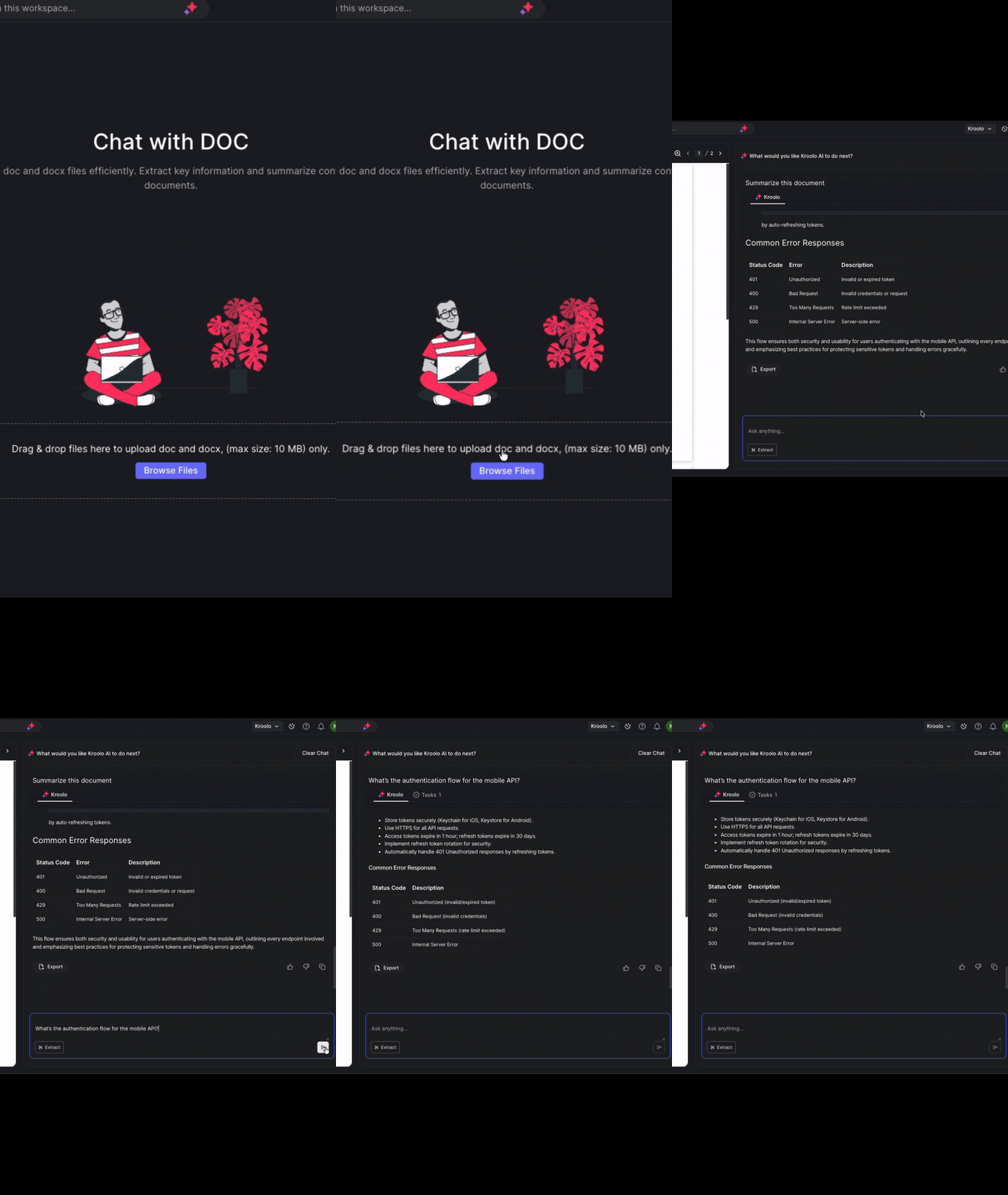
In Kroolo, documents aren’t static files or forgotten attachments. PDFs, wikis, and strategy docs become living knowledge sources. Teams can generate docs with AI, summarize long content and compare versions, and—most importantly—chat with documents to extract answers instantly. Knowledge stays searchable, usable, and connected to execution.
2. Action (Projects & Boards)
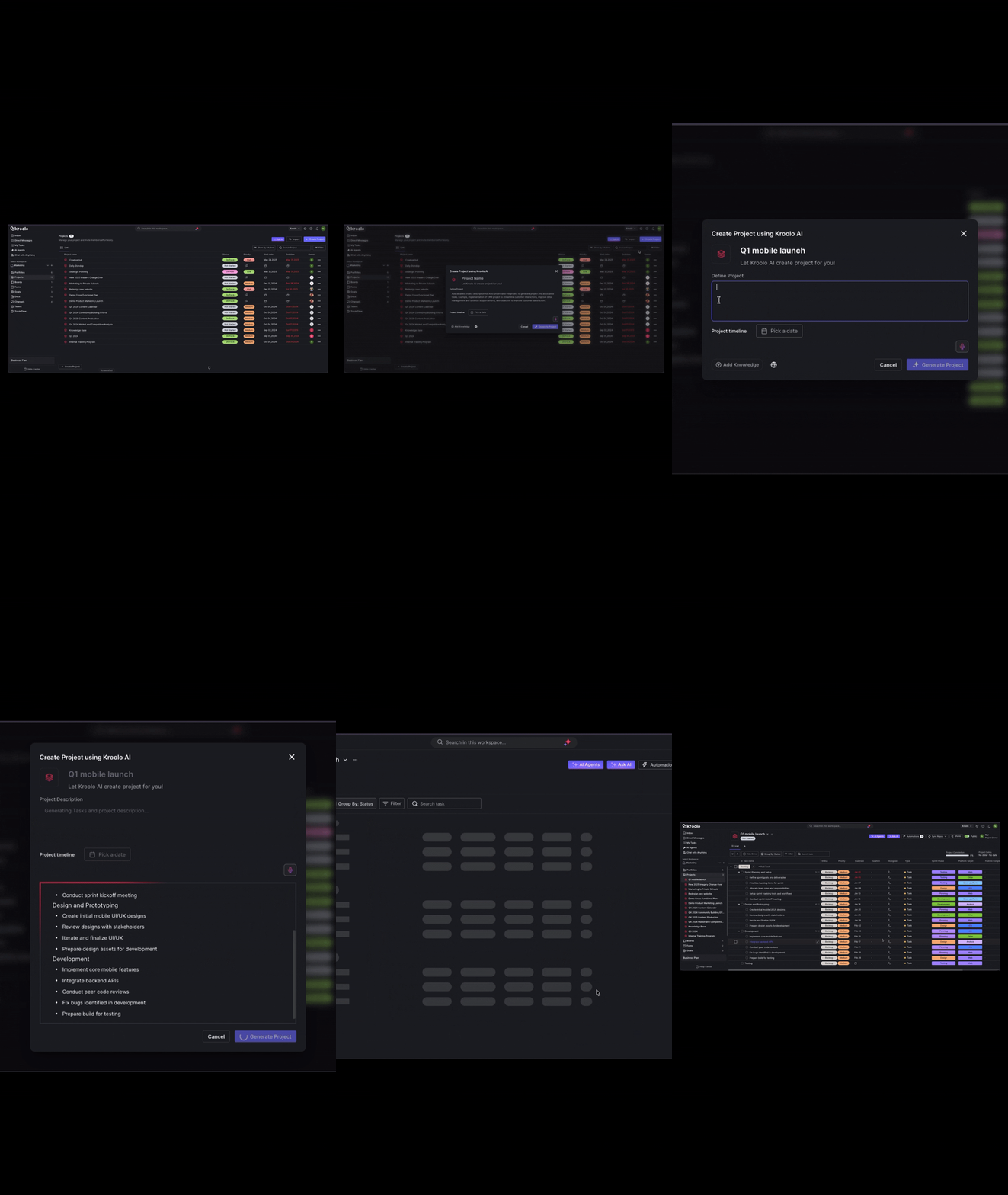
Work in Kroolo is created directly from context. Upload a client brief, RFP, or technical spec, and AI generates a structured project board with tasks, subtasks, workstreams, and dependencies. Boards can be refined with prompts, automated with rules, and tracked through dashboards, sprints, and workload views—without manual setup overhead.
3. Talk (Chat in Context)
Conversations don’t live beside the work—they live inside it. Teams can chat with projects, boards, or individual tasks to get summaries, identify risks, or surface blockers. Decisions stay tied to the work they affect, eliminating lost context and follow-up confusion.
A PDF is no longer an attachment — it’s the blueprint for execution
A chat thread isn’t a dead end — it drives action inside projects
A task list isn’t manual admin — it’s AI-assisted execution
Instead of stitching together Slack for talk, Notion for knowledge, and Monday or ClickUp for execution—with integrations and workarounds in between—Kroolo replaces fragmentation with one intelligent operating layer.

Consider a 30-person engineering organization running the standard fragmentation stack: Jira for tickets, Slack for communication, Confluence for documentation, GitHub for code, and Monday.com for roadmap planning.
Time lost per sprint: Approximately 32 hours across the team just managing tool overhead, fragmented context, and information retrieval.
The same team migrates to Kroolo's unified workspace:
Time saved per sprint: 28 hours—returning nearly a full developer-week to actual development rather than tool choreography.
The transformation isn't just about efficiency metrics. Engineering leads report higher code quality because developers maintain deeper focus.
Product managers report faster feature validation because feedback loops are tighter. Teams report better morale because the cognitive load of "managing the system" drops dramatically.
Conclusion
The takeaway for 2026 is that consolidation is the only viable solution to the fragmentation crisis of the mid-2020s. Moving to an AI-Native WorkOS is not just a cost-cutting measure; it is a strategic upgrade that removes administrative friction and allows your team to focus on the work they were hired to do.
According to McKinsey, AI-native firms are already outperforming their legacy peers in both innovation speed and employee retention. The future belongs to those who stop managing work and start automating it. The toggle tax is an optional expense—one that you can stop paying today.
Stop the Toggling. Start the Flowing. Start for Free Today—experience the only platform built from the ground up for the AI-enabled enterprise.