

Apr 02, 2026
-
By Clive
The $2.5M Problem Hiding in Your Chat Threads
Let's start with a number that should bother every executive in the room.
The average employee spends 2.5 hours every single day just searching for information.
Not doing the work. Not making decisions. Just hunting. Across Slack channels, Teams threads, shared drives, and old email chains — hunting.
Multiply that across a 200-person organization and you're looking at thousands of hours evaporating every month.
Not from laziness or poor management, but from a structural problem nobody has properly solved yet: your company's knowledge is scattered, and your tools were never built to unify it.
And it gets worse. Employees spend 21% of their work time searching for knowledge and another 14% recreating information they couldn't find. Your team isn't just losing time — they're redoing work that's already been done, somewhere, by someone, in a thread nobody can locate.
That's not a productivity issue. That's a revenue leak.
Most enterprise search tools don’t fix the problem—they just speed up a broken process.
You still get links. You still open multiple tabs. You still ask around.
The tool finds the document—but you do the work of turning it into action. That’s Discovery Toil—and it’s one of the highest hidden costs in modern enterprises.
At scale, it gets worse. Platforms like Slack and Microsoft Teams generate massive amounts of knowledge daily—but once conversations scroll away, they’re practically lost.
The impact?
This isn’t just inefficiency. It’s a revenue leak—showing up in missed timelines, wasted effort, and bloated tech stacks.
Here’s how the existing tools like Slack or Microsoft Teams stack up:-
This is genuinely good — within Slack's walls. It can surface messages, files, and now, with RAG-powered AI, even summarize threads intelligently.
But the moment a decision was made in a Teams meeting, or the relevant file lives in Jira, Slack search draws a blank. It's intelligent inside one room of the house, completely blind to the rest.
It is impressive if your entire organization runs on Microsoft 365. Meeting recaps, document summaries, in-suite search — all strong.
But if even a third of your team's work happens outside the Microsoft ecosystem — in Slack, Notion, Salesforce, HubSpot — Copilot simply doesn't know it exists. It's an intelligence layer built for Microsoft, not for your organization.
Yes, such tools often cross the platform gap and are capable products. But they introduce a different problem: heavy IT configuration, complex permission models, high licensing costs, and most importantly, they still only return answers.
They don't help you act on them. You read the result, then switch back to your work, manually. That gap between finding and doing is exactly where the productivity loss lives.
The honest assessment of the entire category is this: these tools were all built to answer "Where is the information?" None of them were built to answer "What should happen next?"
The shift happening right now in enterprise intelligence is not about faster indexing or better keyword matching. It's about moving from passive retrieval to active execution.
The best enterprise search for Slack and Microsoft Teams in 2026 doesn't hand you a link and walk away.
It understands context, synthesizes information across every platform your team uses, delivers a clear, cited answer in plain language — and then lets you turn that answer into action without ever leaving the chat.
That's the bar. And most tools are nowhere near it.
Kroolo was built from the ground up as an AI-Native WorkOS — not a search plugin, not an add-on, but a unified intelligence layer that lives directly inside Slack and Microsoft Teams as a native chatbot. Your teams don't learn a new tool. They just ask a question in the interface they already have open.
Here's what most search tools won't tell you. Finding the file is only step one. After that, your team still has to open the document, pull out the relevant context, switch to the project board, create the task, write the brief, and loop in the right people on Slack.
It's a Productivity Paradox baked into the architecture of your tech stack. More tools, more search capability, and somehow, less organizational velocity.
Kroolo was built specifically to close that gap.
Kroolo connects Slack, Google Drive, Jira, Salesforce, Zendesk, and more into a single, unified, live knowledge layer — not a passive index that goes stale the moment someone updates a document.
Everything syncs in real time. Your team always knows what's available, what's current, and where it came from.
And because Kroolo treats Slack and Microsoft Teams not as two separate silos but as one unified knowledge graph, every message, every file, every decision across both platforms becomes instantly queryable from a single interface.
The communication fragmentation problem doesn't get managed — it gets eliminated.
A project manager types: "What did we decide on the Q3 roadmap last Tuesday, and who's responsible for the follow-up?"
Kroolo doesn't return a list of links. It returns a structured, cited answer — pulled from the relevant Slack thread, the Jira board, and the linked Drive document — with a one-click option to create a task or update the project board directly.
This is Kroolo's Agentic RAG at work. It doesn't just retrieve — it interprets, synthesizes, and connects the answer to the action that needs to happen next.
Searching for "customer retention" surfaces churn reduction insights even if those exact words never appeared in the document. The system understands meaning, not just syntax.
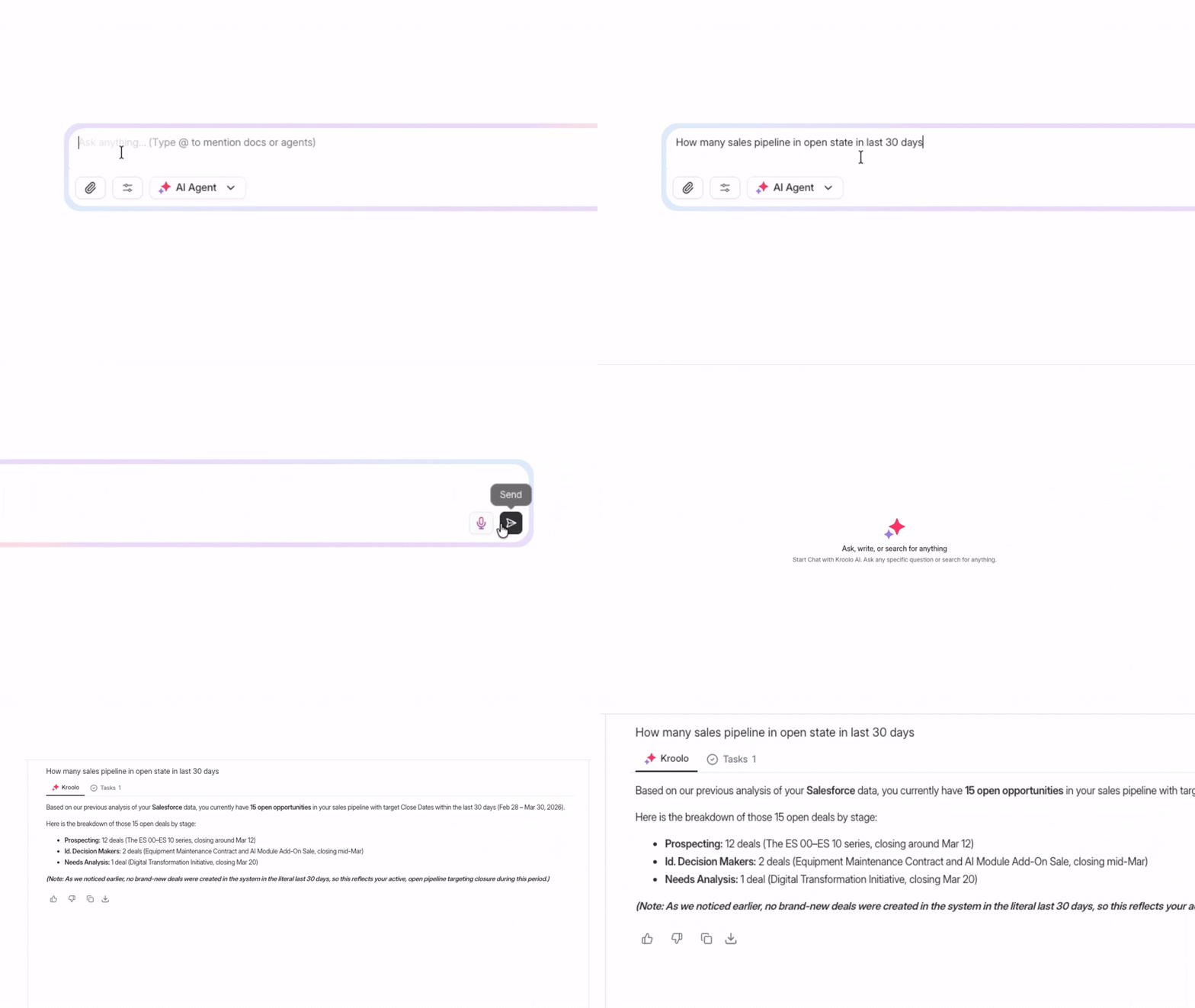
Inside Kroolo's Enterprise Search, your team doesn't browse results — they have a conversation with them. Ask a follow-up. Narrow it down by date, by person, by project.
Every answer comes with source references, relevance scores, and direct access to the underlying file.
A full task log shows exactly how the answer was generated — giving enterprise teams the auditability and traceability they can't afford to operate without.
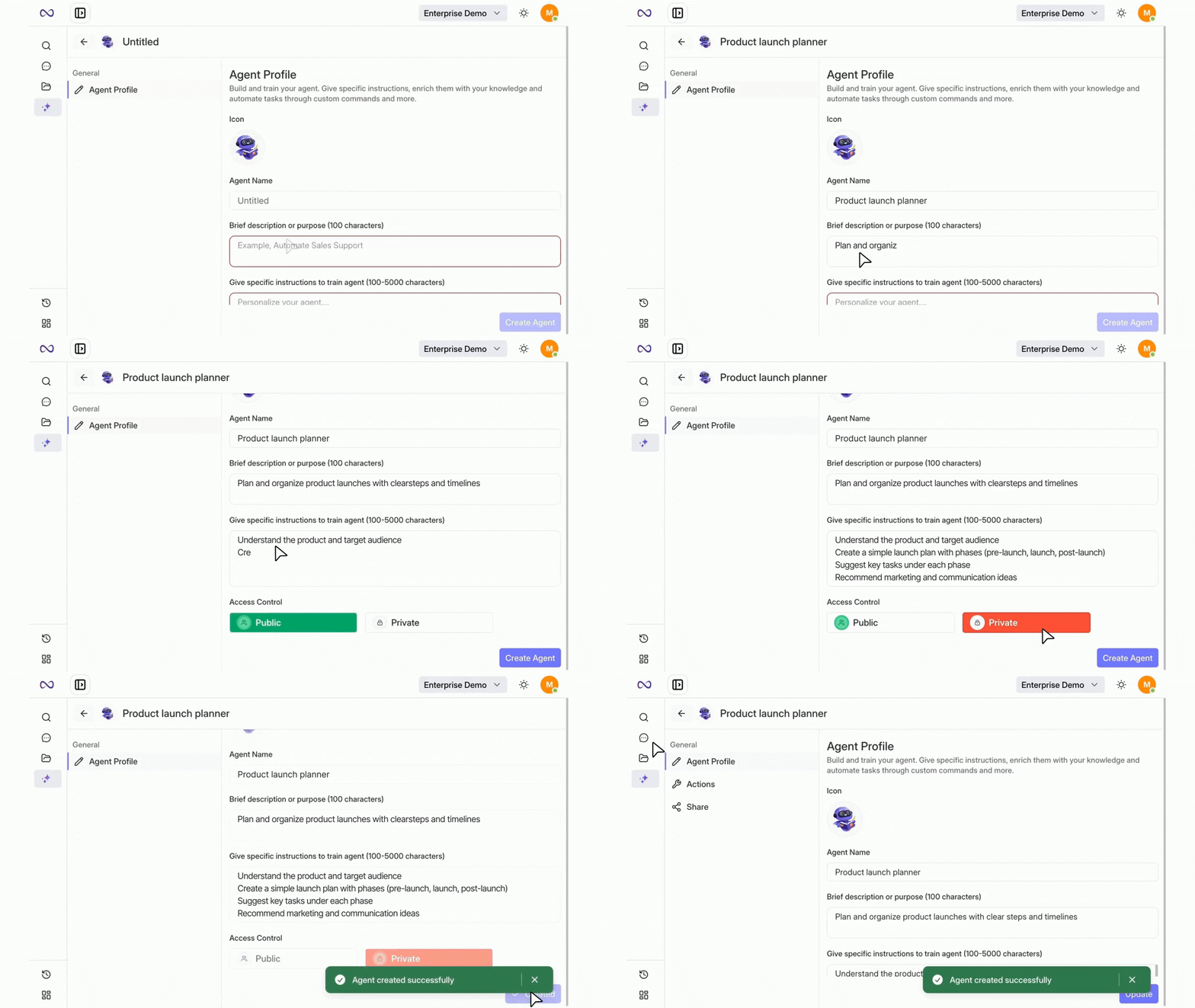
For teams with specific needs, Kroolo lets you build and deploy custom AI agents — trained on your workflows, your data, your access rules.
A support team gets an agent scoped to product documentation and past resolutions. A sales team gets one pulling live context from Salesforce. A finance team gets one surfacing only contracts and approval records.
Each agent doesn't just answer questions. It executes — drafting content, generating summaries, delivering structured outputs.
This is the shift from tools that hand you a link to systems that actively complete the work.
For IT Directors and CTOs rationalizing tech stacks, Kroolo is SOC 2 compliant, enforces Role-Based Access Control across every connected system, and directly consolidates the need for separate search tools, knowledge bases, and workflow automation platforms.
One platform. One intelligence layer. Your entire organization's knowledge — finally actionable.

A Support Lead at a mid-market company was dealing with a familiar problem: recurring “Bluetooth bug” complaints coming in from multiple directions.
Customer issues were being discussed across 20+ channels in Slack, while related documentation and past resolutions lived separately in Microsoft Teams.
Finding patterns meant:
It was slow, fragmented, and highly repetitive.
Instead of digging through threads, the Support Lead used the Kroolo chatbot directly inside Slack and asked:
“What are the common denominators for the Bluetooth issues reported this month?”
Kroolo instantly:
But it didn’t stop there.
From the same response, the Lead could:
All without leaving the chat interface.
What previously took hours of manual effort was reduced to minutes.
This is the shift Kroolo enables:
By unifying knowledge across Slack and Microsoft Teams, Kroolo turns scattered conversations into actionable intelligence—right when teams need it.
For growing organizations, this means:
Kroolo doesn’t just help teams find problems. It helps them solve them—immediately.
Conclusion
2026 is not the year of more tools. It's the year of fewer, smarter ones.
The fragmentation crisis inside Slack and Microsoft Teams was never really a search problem. It was always an intelligence gap — the distance between knowing where information lives and being able to act on it without breaking your team's flow.
Every search-only tool addresses the first half and ignores the second. In 2026, that half-solution is no longer acceptable.
Kroolo closes the full loop. The semantic intelligence to surface the right answer from across your entire Slack and Teams environment. The agentic power to turn that answer into a task, a decision, or a workflow — without your team ever leaving the interface they're already in.
This is AI-Native Consolidation. The shift from manual knowledge management to automated execution. From an organization that hunts for answers to one where answers instantly become action.
The toggle tax ends here.
Ready to Stop Searching and Start Executing?
Sign Up for Free and experience the only Enterprise Search built for how your team actually works.