

Search is one of the most underestimated problems in modern organizations.
Every day, teams spend hours trying to find:
- The latest project update
- A critical document
- A decision buried in chat
- Data spread across multiple tools
And despite having more tools than ever, the problem is only getting worse.
According to a McKinsey report, employees waste 1.8 hours every day or nearly a quarter of their workweek just searching for information.
This isn’t just inefficiency.
It’s a systemic failure in how enterprise knowledge is organized and accessed.
What is Enterprise Search in 2026?
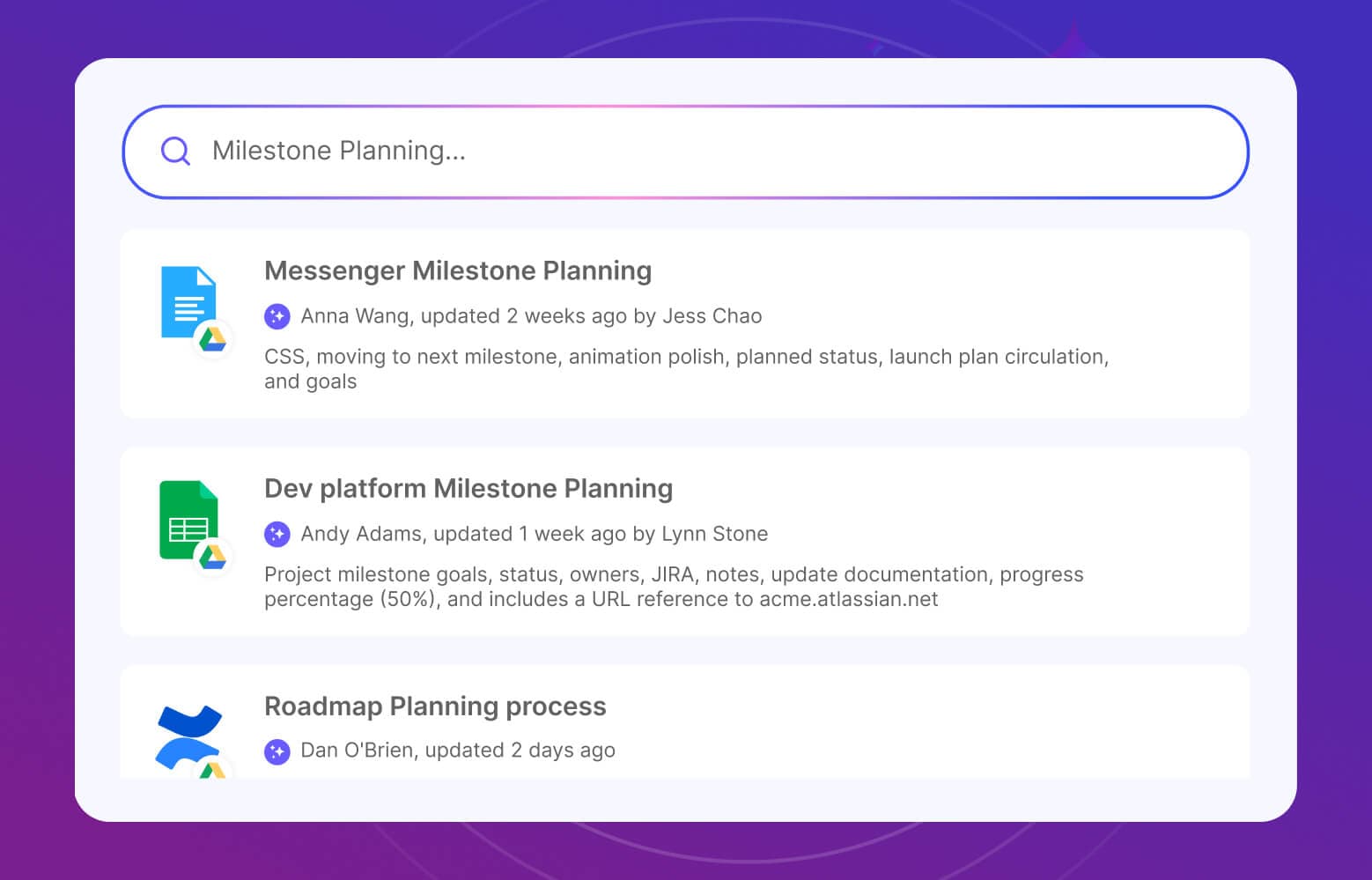
Enterprise search has evolved far beyond “finding files.”
Today, it is expected to:
- Deliver answers, not links
- Understand context across tools
- Enable instant action
However, most traditional systems still:
- Index documents without understanding them
- Search within silos instead of across systems
- Return lists of results instead of clear decisions
The gap between what search should do and what it actually does is massive.
The Core Problem: Enterprise Knowledge is Fragmented
Modern organizations operate across a complex ecosystem of tools:
- Project data in Jira, Asana, and Monday.com
- Conversations in Slack and Microsoft Teams
- Documents in Google Drive and SharePoint
- Knowledge in Confluence and Notion
- Customer data in Salesforce and HubSpot
- Support systems like Zendesk and ServiceNow
Each tool solves a specific problem.
But together, they create a new one:
Knowledge is everywhere — but usable insight is nowhere.
Why Traditional Enterprise Search Fails
Most enterprise search tools were built for a different era.
They fail because they:
- Lack deep context across systems
- Ignore relationships between data
- Cannot reason or summarize information
- Cannot take action on insights
The result?
Teams don’t get answers. They get more work.

Introducing Kroolo Enterprise Search
Kroolo Enterprise Search is an AI-native search and intelligence layer designed for modern enterprises.
It doesn’t just connect your tools — it understands and acts on them.
It transforms search from:
“Find me something…”
into
“Give me the answer. And take action.”
How Kroolo Enterprise Search Works
Kroolo is built on a multi-layer AI architecture designed to handle real-world enterprise complexity.
1. Unified Data Layer: One Source of Truth
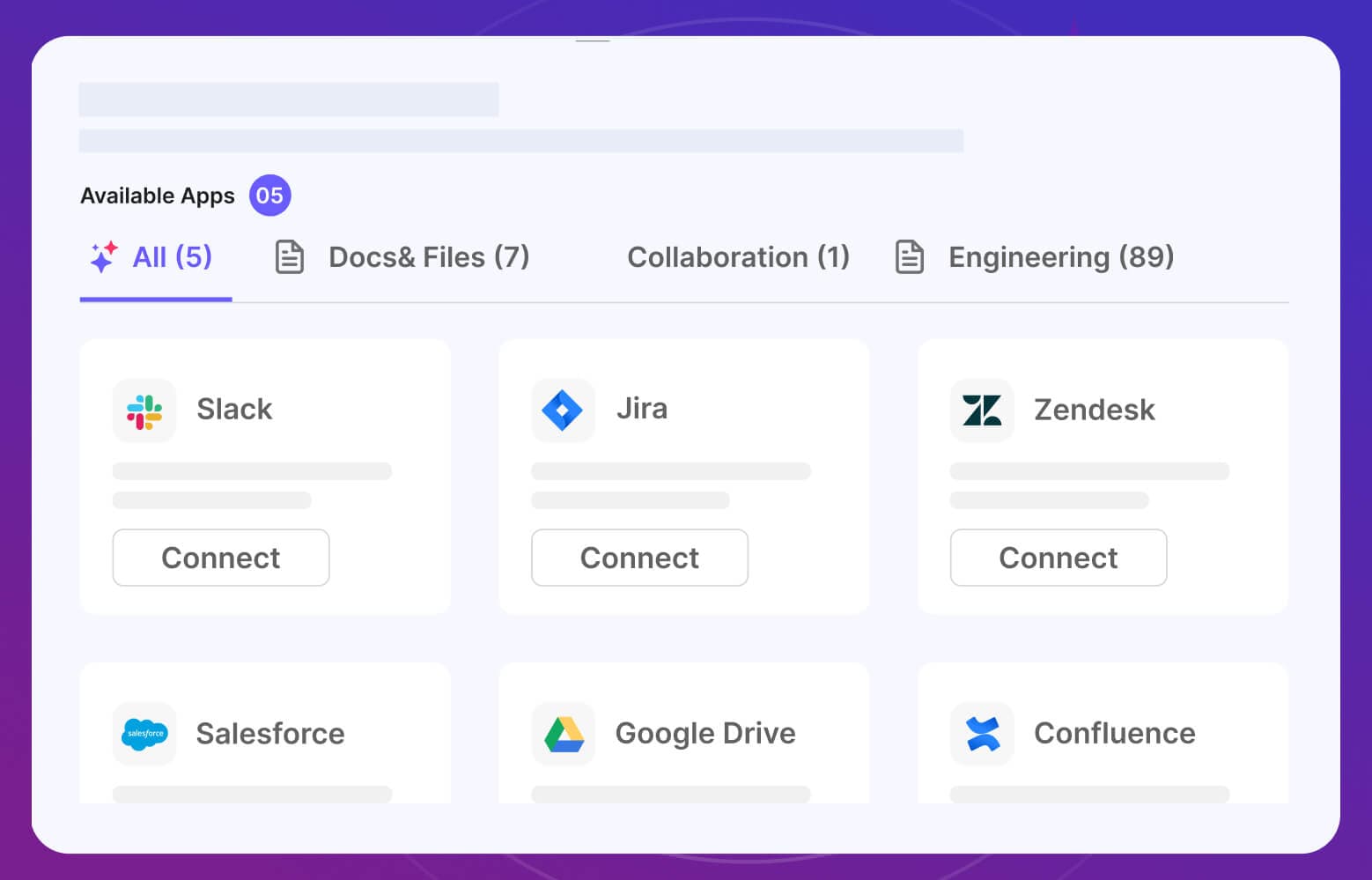
Kroolo connects across your entire ecosystem:
- Work tools (Jira, Asana, ClickUp)
- Collaboration platforms (Slack, Teams)
- Knowledge bases (Confluence, Notion)
- Storage systems (Drive, SharePoint)
- CRM and ITSM platforms
All data is:
- Synced in real time
- Enriched with metadata and semantics
- Secured with permission-aware access (ACLs & RBAC)
Outcome: A unified, secure, and always up-to-date data foundation.
2. Hybrid AI Search Engine: Precision + Intelligence
Kroolo combines multiple search technologies:
- Semantic search powered by LLMs
- Keyword-based retrieval (BM25)
- Knowledge graph relationships
- Context-aware ranking (RRF)
This ensures:
- Higher accuracy
- Better relevance
- True cross-application understanding
3. Answer Engine: From Results to Insights
Unlike traditional tools, Kroolo doesn’t return documents.
It generates:
- Direct answers
- Multi-source summaries
- Contextual insights
Example Query:
“Which projects are delayed and why?”
Kroolo Response:
- Identifies delayed projects
- Pulls blockers from project tools
- Extracts risks from team conversations
- Links relevant documents
All in one unified response.
4. Action Layer: From Search to Execution
This is where Kroolo redefines enterprise search.
From a single query, users can:
- Create or update tasks
- Generate reports (PDF, Excel, PPT)
- Trigger workflows
- Draft documents
- Approve or assign work
Search becomes a decision and execution engine.
Key Capabilities That Drive Real Impact
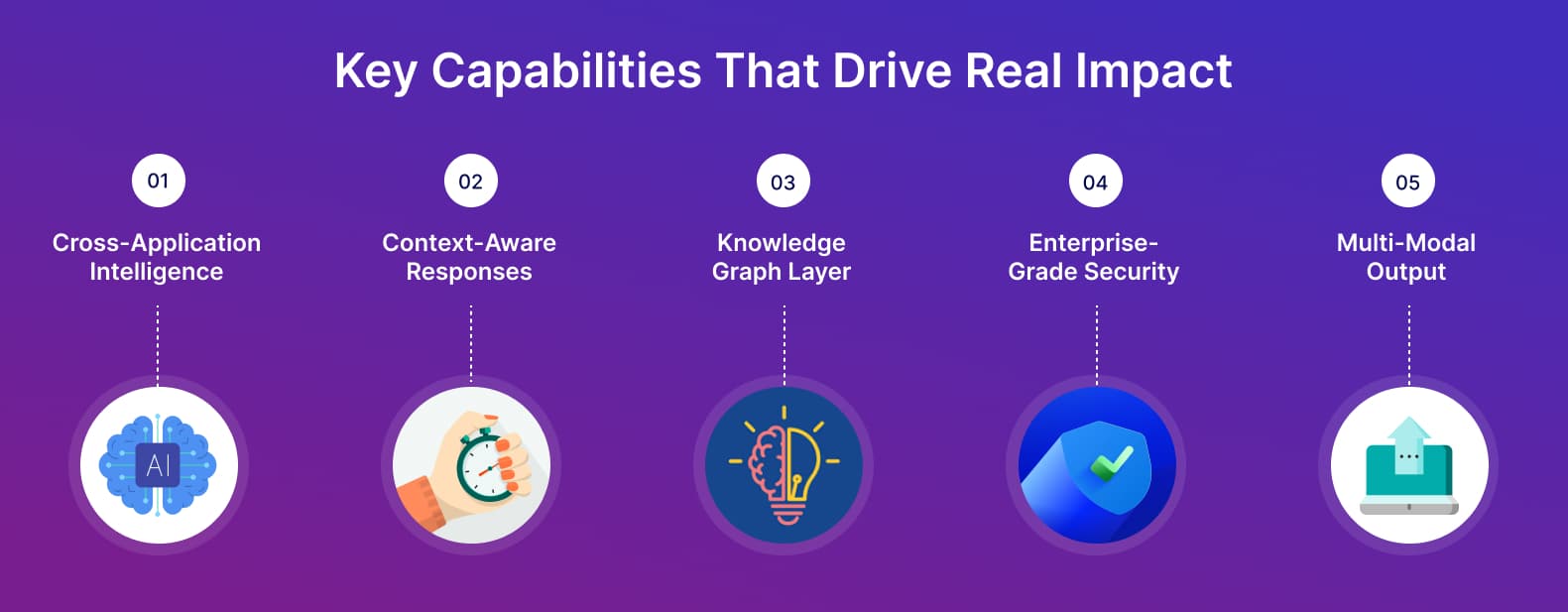
What makes modern enterprise search truly powerful is not just speed — it’s the ability to understand, connect, and act on information in context.
Kroolo Enterprise Search is built around a set of core capabilities that directly impact how teams work every day.
1. Cross-Application Intelligence
In most organizations, information is scattered across multiple tools — each holding a piece of the bigger picture. The challenge isn’t access, it’s fragmentation.
Kroolo eliminates this by enabling search across 10+ tools through a single interface. Instead of switching between platforms, logging into different systems, or manually stitching together information, users can retrieve everything they need in one place.
This creates a unified view of work — where conversations, documents, tasks, and data are no longer isolated, but connected and instantly accessible.
2. Context-Aware Responses
Not all information is relevant to everyone.
Kroolo goes beyond generic search results by delivering context-aware responses tailored to each user. It understands:
- Your role within the organization
- The projects you’re involved in
- Your access permissions
- Your recent activity and context
This ensures that every answer is not just accurate, but meaningful and actionable for you.
Instead of overwhelming users with data, Kroolo delivers the right insight, at the right time, in the right context.
3. Knowledge Graph Layer
Enterprise data is not just a collection of documents — it’s a network of relationships.
Kroolo’s knowledge graph layer maps connections between:
- People and the work they own
- Tasks and the projects they belong to
- Conversations and the decisions they influence
- Documents and the outcomes they support
By understanding these relationships, Kroolo can surface insights that traditional systems miss.
For example, it doesn’t just show a task — it shows:
- Who is responsible
- What dependencies exist
- What discussions are linked
- What risks are emerging
This transforms search from static retrieval into dynamic understanding.
4. Enterprise-Grade Security
In enterprise environments, access control is as important as accessibility.
Kroolo is built with security at its core, ensuring that data is always protected while remaining easily accessible to authorized users.
It enforces:
- Role-Based Access Control (RBAC) to manage permissions at scale
- Access Control Lists (ACLs) to ensure users only see what they’re allowed to
- Strict safeguards to prevent data leakage across teams or roles
With compliance readiness for standards like SOC2 and GDPR, organizations can confidently adopt AI-powered search without compromising on security.
5. Multi-Modal Output
Modern work doesn’t end with finding information — it requires turning that information into usable outputs.
Kroolo enables users to generate multiple types of outputs directly from search results, including:
- Detailed reports
- Real-time dashboards
- Concise summaries
- Structured documents
This means users can move from insight to output instantly, without needing to switch tools or start from scratch.
Instead of spending hours compiling information, teams can focus on analyzing, deciding, and executing.
Individually, these capabilities are powerful.
Together, they redefine what enterprise search can do.
Kroolo doesn’t just help teams find information — it helps them:
- Understand it in context
- Connect it across systems
- Act on it immediately
And that’s what drives real impact — not just faster search, but smarter work.
From Search to Knowledge: A Self-Learning System
Every interaction strengthens the system.
Kroolo automatically builds a unified knowledge hub by capturing:
- Search queries and results
- AI-generated answers
- Team conversations
- Decision context
Over time, your organization gains a persistent, searchable intelligence layer.
Why Kroolo Stands Out
Compared to alternatives:
- Glean → Strong retrieval, limited action layer
- Microsoft Copilot → Works best within Microsoft ecosystem
- Kroolo → Works across all tools + takes action
Kroolo is:
- Open and integration-first
- AI-native from the ground up
- Built for execution, not just discovery
Why Enterprise Search Matters More Than Ever
We are entering a new phase of enterprise AI:
Systems that don’t just assist…
but think, connect, and act.
But without solving search:
- AI cannot access the right data
- Insights remain fragmented
- Automation fails
Enterprise search is no longer optional. It is foundational.
The Future of Enterprise Search
The next generation of enterprise search will evolve across three stages:
Search → Intelligence → Autonomy
It will:
- Be deeply integrated across workflows
- Continuously learn from organizational behavior
- Act as a central decision-making layer
- Execute tasks proactively
From Search to Action: The New Standard
The problem was never a lack of tools — it was the lack of intelligence between them.
You don’t need another platform to manage.
You need a system that works with you — and for you.
A system that:
- Understands your work
- Connects your data
- Acts on your behalf
Because modern enterprise search isn’t about retrieving information anymore.
It’s about turning information into action.
That’s the shift.
That’s the standard.
That’s what Kroolo delivers.
Ready to Experience It?
Stop searching. Start executing.
Sign up for Kroolo today and see how Enterprise AI can transform the way your team works