

Apr 03, 2026
-
By Ivan
Every minute your team spends searching for information is a minute stolen from execution.
In 2026, a search bar that just gives you a link is a relic.
If your team is still toggling between Google Drive docs and Salesforce records—opening tabs, copying context, and manually turning insights into action—you don’t have a search problem.
You have a system design problem.
Because in 2026, the bottleneck in your organization is not that your team can't find information. It's that after they find it, they're still manually toggling between five other tools to do anything about it. And no one is pricing that cost into the search vendor evaluation.
This post is for leaders ready to ask a better question: “Which architecture actually gets work done?”
Yes. Kroolo searches across Google Drive and Salesforce.
It does so with:
So if that was your only question, you have your answer.
But if you stop there, you're leaving the most important part of the evaluation on the table.
This happens thousands of times daily:
A project manager searches for a contract in Google Drive using Glean. The document appears instantly.
Then what?
Result: 5 tools. 7 minutes. 1 unit of progress.
Glean worked perfectly. Your workflow didn’t. This is the Search-to-Action Gap—where discovery ends and fragmentation begins.
Most organizations underestimate the true cost of tool fragmentation because it doesn't show up as a line item. It shows up as a 4-hour daily drag on your highest-paid talent.
Research on context-switching is unambiguous: Every time an employee switches from one application to another, it takes an average of 23 minutes to fully reorient.
Multiply that across 20 switches a day, across a team of 50 people, and you're looking at hundreds of hours of lost deep work every single week — paid for at senior engineer or strategic analyst rates.
This is the Toggle Tax. It is one of the most significant and least-quantified drains on enterprise output. And deploying a standalone search tool like Glean reduces exactly zero dimensions of it.
Glean makes the finding faster. The toggling, the manual task creation, the cross-app coordination — all of that remains unchanged. You've added one more vendor to your renewal cycle, one more integration to maintain, and one more login for your team to manage. The problem you actually needed to solve is still fully intact.
For an executive responsible for modernizing the tech stack, that is not a productivity investment. That is an expensive band-aid on a structural wound.

Let's be direct: Glean is well-engineered software solving a real problem. Enterprise-grade semantic search across unstructured data is genuinely difficult.
Permission-aware indexing that respects access boundaries across Google Drive, Salesforce, Slack, and dozens of other connectors is non-trivial infrastructure work. For organizations that had no centralized search at all, Glean represented a meaningful step forward.
If your team was running keyword searches across three different portals and getting nothing back, moving to semantic search is a real upgrade. The problem is not what Glean does. The problem is where it stops.
Glean's product search architecture reflects the era it was designed for — an era when AI's role in the enterprise was narrowly defined as retrieval. Find the doc. Surface the email thread. Locate the CRM record. That era is over.
The modern enterprise doesn't have an information access problem. It has an information action problem.
The gap between finding data and doing something productive with it is where organizational momentum goes to die. Glean sits upstream of that gap and calls the job finished.
Yes — Kroolo searches across Google Drive and Salesforce. Just like Glean.
But the moment you frame this as a search comparison, you've already asked the wrong question.
Because Kroolo wasn't designed to index your tools and hand you a link. It was designed to turn your entire stack into a unified, intelligent system where finding something and doing something happen in the same breath.
Here's what that actually looks like inside the product.
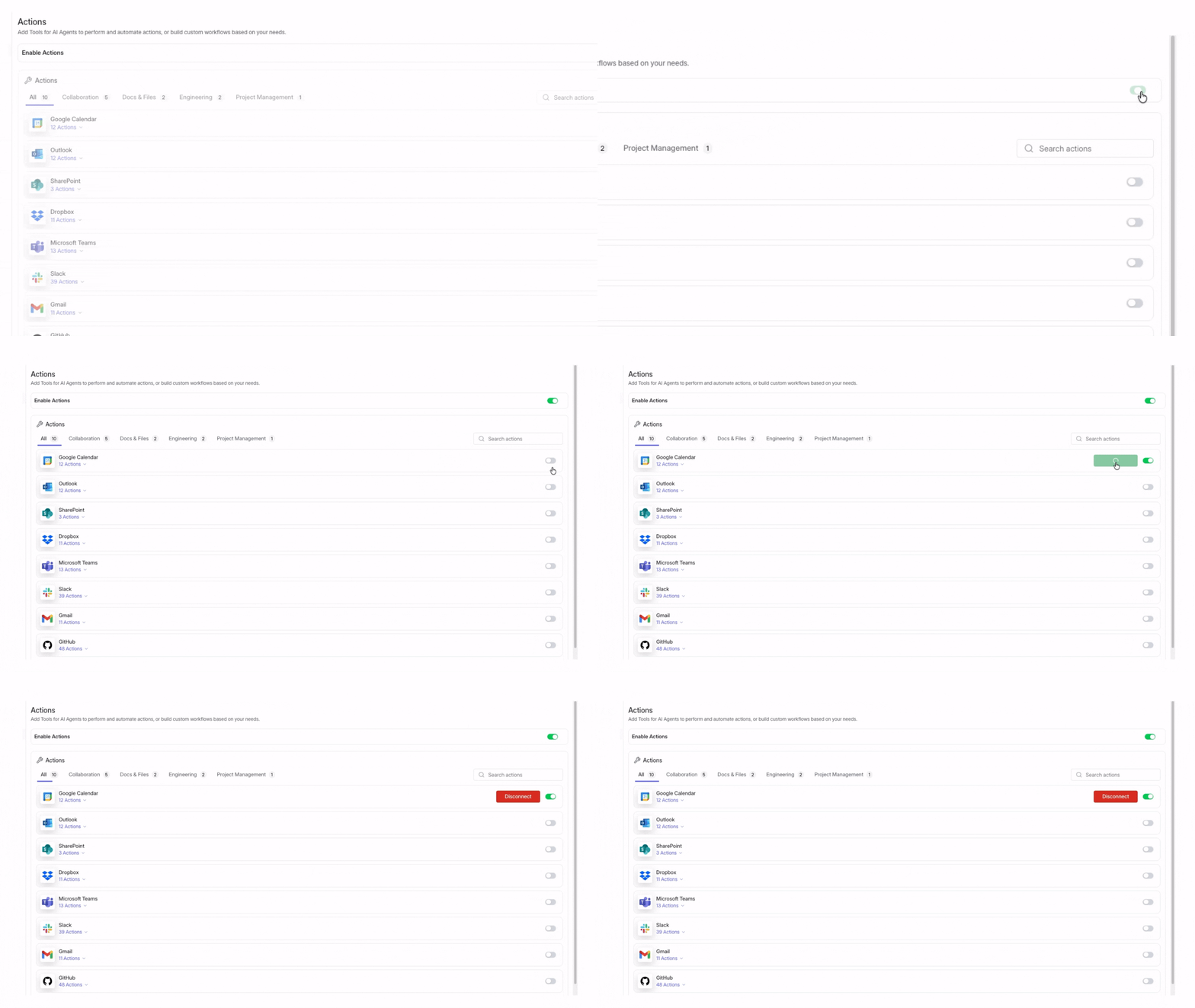
Kroolo's Enterprise Search begins where every other tool stops — full-stack unification.
What connects: Google Drive, Salesforce, Slack, Jira, Zendesk, HubSpot, GitHub, Xira, and more — with additional integrations continuously added.
How it stays current: Real-time auto-sync means no stale indexes, no manual re-crawls, no data gaps. Every connected source is live. One query fires across all of them simultaneously — no silos, no duplication, no tab-switching required.
What you control: Sync at the folder level or across everything. A real-time progress bar tracks indexing status. Filter by source at any point. The Knowledge Base accepts drag-and-drop file uploads, manual URL entries, and full sitemap crawls with custom include and exclude paths.
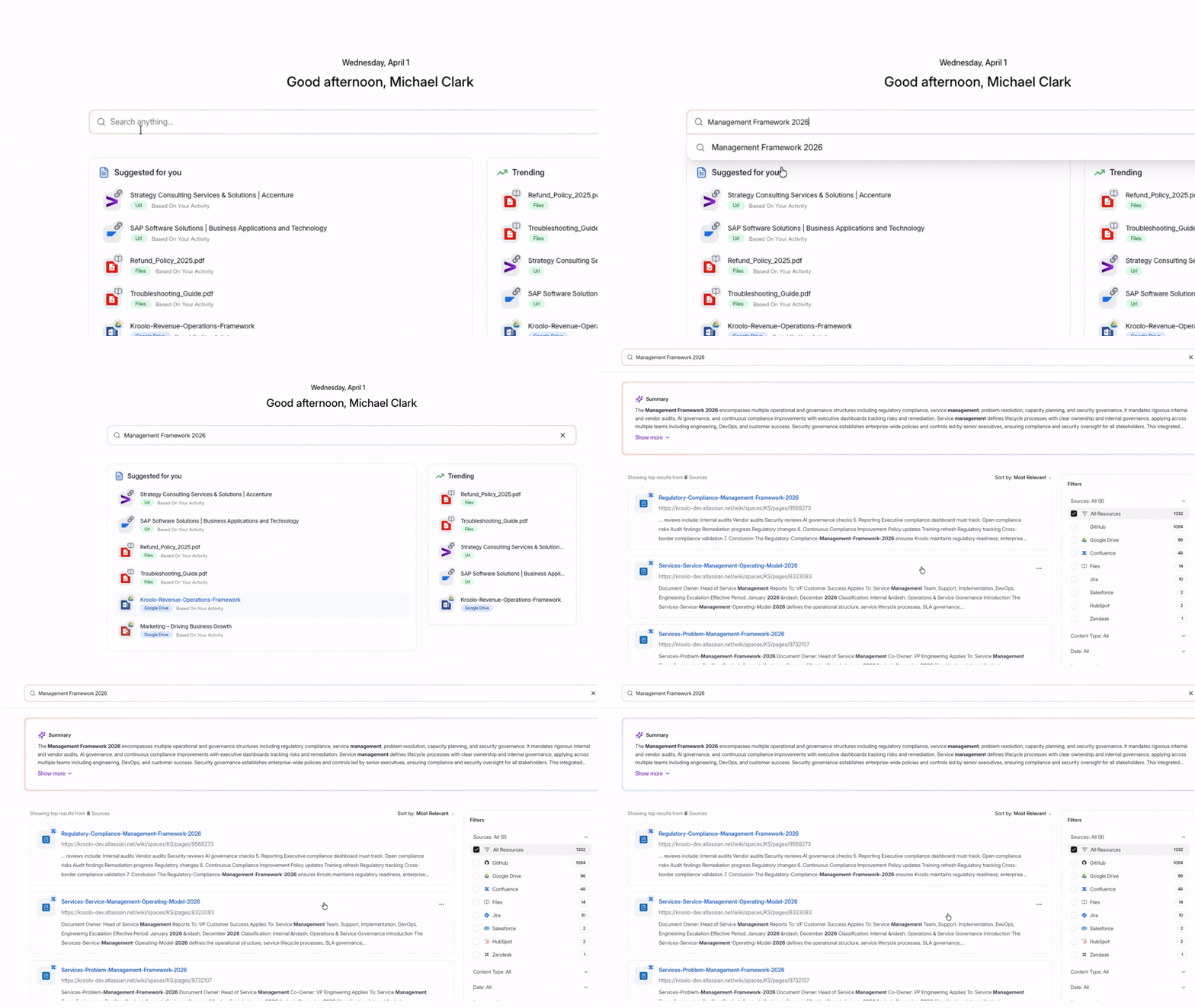
Most enterprise search tools match what you type. Kroolo understands what you mean.
Its AI-powered semantic engine processes:
The result: instead of a list of keyword hits, you get a ranked, role-aware, contextually relevant set of results — in seconds.
Enterprise search is only as valuable as it is trustworthy. Kroolo enforces security at every layer — without slowing anything down.
What's built in:
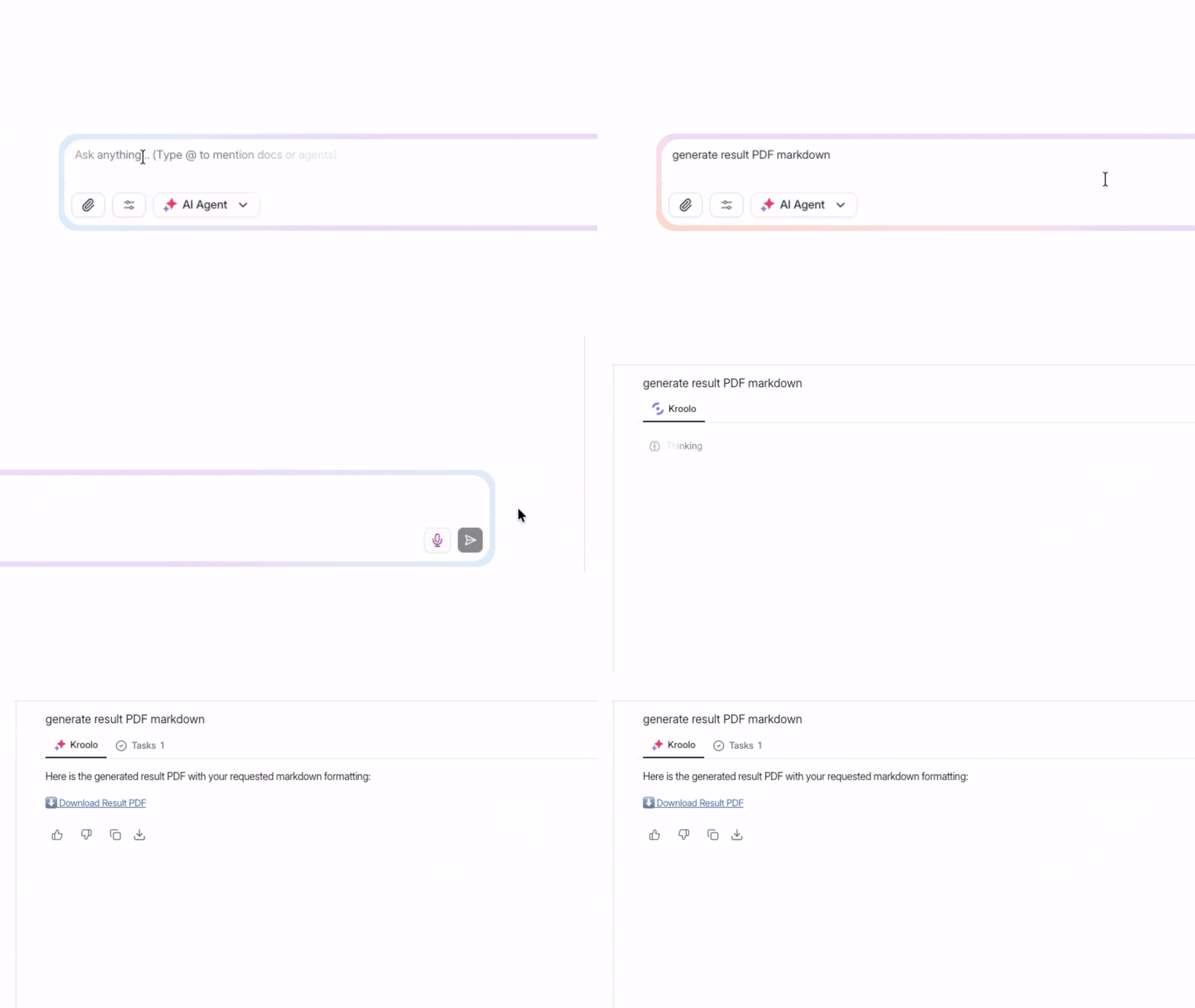
This is where Kroolo leaves keyword-era search tools behind entirely.
Instead of returning links, Kroolo's Chat in Enterprise Search lets your team hold a direct conversation with their connected organizational data.
Ask anything in plain language: "What's our current refund policy?" "Which Salesforce opportunities moved stages last week?" "What did the team decide in the last sprint retrospective?"
The AI retrieves, synthesizes, and delivers a precise answer — not a list of documents to manually sift through. Every response includes full source attribution with relevance scoring, so your team knows exactly where the answer came from and how confident the system is in it.
Outputs can be exported instantly as PDF or Markdown. Every conversation is logged to a searchable chat history — turning every question and answer into permanently retrievable organizational knowledge.
Most tools forget what happened the moment a session ends. Kroolo does the opposite.
Every search query, every AI-generated answer, every team conversation is captured and preserved in a Unified Knowledge Hub — a persistent, ever-deepening organizational memory that grows more valuable the more your team uses it.
What this means in practice:
No manual documentation required. The knowledge base builds itself.
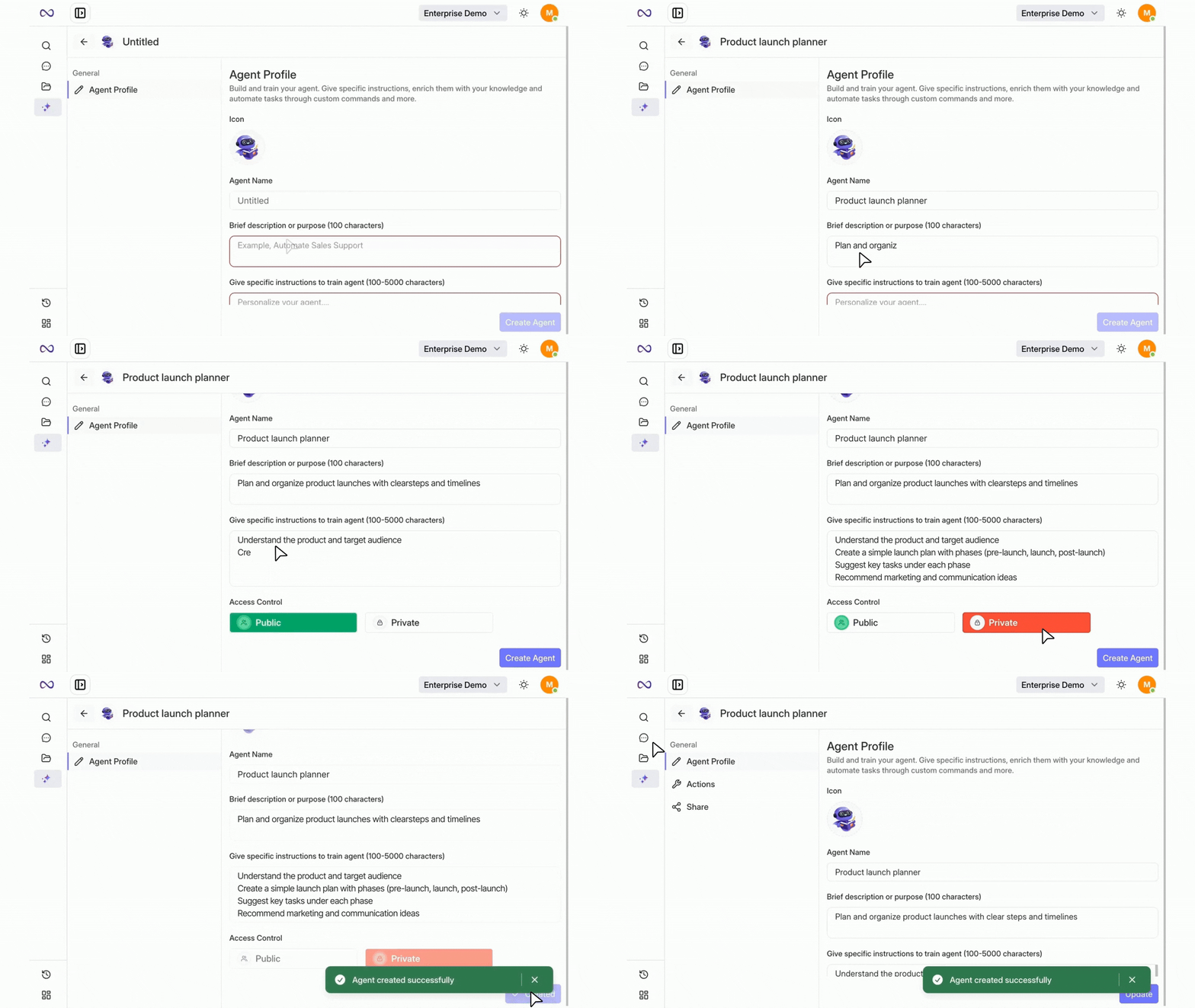
Kroolo's Custom AI Agents are the capability that no standalone search tool can replicate — and the one that most directly eliminates the Search-to-Action Gap.
Build an agent for any workflow:
This is the feature that makes every previous section matter.
Kroolo closes the loop that every other search tool leaves open. From any search result, your team can:
No tab switching. No copy-pasting between tools. No manual follow-up. The action happens where the search happened.
Glean proves you can search across Google Drive and Salesforce.
Kroolo proves that searching is only the beginning.
In modern enterprises, the problem your team faces every day is not "Can I find the file?" It is "Can I do something with it — right now, without opening four more tools?"
Glean answers the first question well. Kroolo makes it irrelevant — by answering both at once.
Kroolo doesn't just unify your data. It activates it.
At a mid-market software company scaling its support operations, a Support Lead named Priya faced a problem that was equal parts technical and organizational.
Over the course of four weeks, customer complaints about a Bluetooth connectivity bug had been trickling in — and then flooding in. The reports were real, the frustration was mounting, and engineering needed answers.
But the information Priya needed to build that case wasn't sitting in one place. It never is.
It was scattered across:
Manually sifting through all of it wasn't just inefficient. At the volume of channels involved, it was functionally impossible without dedicating days to the investigation — days Priya didn't have, with an engineering sprint planning session two hours away.
The real problem wasn't the Bluetooth bug.
The real problem was organizational amnesia. Dozens of people across the company had already observed, discussed, and partially diagnosed this issue. That intelligence existed. It just wasn't findable.
Before Kroolo, here's how this investigation would have unfolded:
By the time the sprint planning meeting started, the best Priya could offer would be a partial picture — a few Slack screenshots, a handful of ticket IDs, and a gut feeling about the root cause.
With Kroolo connected to Slack, Teams, Zendesk, Google Drive, and Jira, Priya opened the Kroolo AI Chat and typed a single, plain-language question:
"What are the common denominators for the Bluetooth issues reported this month?"
What happened in the next 11 seconds:
Kroolo's semantic search engine fired across every connected source simultaneously — all Slack channels, archived Teams threads, Zendesk tickets, and Drive documentation. It didn't match the keyword "Bluetooth." It understood the concept of Bluetooth-related support issues and retrieved everything contextually relevant across all sources, regardless of how individual contributors had phrased their observations.
The AI synthesized the results and returned a structured, cited summary directly in the chat window.
Summary: Bluetooth connectivity failures are concentrated in firmware version 3.2.1, first deployed on March 4th. Reports spike consistently after device sleep cycles exceeding 8 minutes. 73% of affected users are on Android 13 or higher. The issue was first flagged in #engineering-standup on March 6th, referenced in a QA log (Drive, March 9th), and has appeared in 38 Zendesk tickets since March 11th.
Cited sources returned:
What the AI identified as common denominators:
Here's where Kroolo separated itself from every search tool Priya had used before.
Priya walked into the meeting with:
|
|
|
|
|
|
|
|
|
|
|
|
|
|
|
|
|
|
|
|
|
|
|
|
|
|
|
|
Conclusion
2026 is defined by AI-Native Consolidation.
Tools that solve only half the problem—finding information without helping teams act on it—are already being left behind. The era of stitching together fragmented apps, workflows, and context is ending.
Kroolo is built for what comes next.
By unifying search, knowledge, and execution into a single WorkOS, Kroolo eliminates the fragmentation at the core of modern enterprise inefficiency.
Are you still using search tools that stop at answers?
Sign up for Kroolo for free and experience how AI-native execution actually works.