

May 25, 2026
-
By Julia
Here's a scene every Slack-heavy team knows too well.
Someone asks a question in a channel. Three teammates reply with "I think we covered this last month." Another says "can you search for it?"
The person who originally asked spends the next 12 minutes scrolling through threads, DMs, and pinned messages — and still doesn't find the answer. They give up and ask again in a different channel. The cycle repeats.
This isn't a Slack problem. It's a knowledge access problem. And it's quietly destroying your team's productivity every single day.
IDC research shows that the average knowledge worker spends about 2.5 hours per day — roughly 30% of the workday — just searching for information.
That's not time spent doing creative work, solving problems, or shipping things. That's time spent looking for something that already exists somewhere inside your organization.
And it gets worse.
IDC also found that 22% of content gets duplicated simply because people either can't find the original or don't know it exists at all. Your team is not just losing time — they are actively creating more clutter while trying to escape it.
The knowledge is there. It's in a Jira ticket, a Google Drive folder, a Confluence page, a Slack thread from six weeks ago. The problem is that when someone needs it, they can't reach it — because each tool is a silo, and no single search cuts across all of them.
This is why enterprise search has become one of the fastest-growing categories in workplace software.
Before comparing tools, it's worth naming the actual gap clearly. Slack's built-in search works fine for finding a message you sent two days ago. It falls apart the moment you need to:
Slack search is keyword-based and Slack-only. It doesn't understand what you mean, it doesn't reach outside its own walls, and it has no awareness of the broader knowledge ecosystem your team operates in.
The tools below exist to fix this — but they've each taken a very different approach to who they're fixing it for.
Both Glean and Moveworks are well-known names in the enterprise software space. Both integrate with Slack. Neither was actually built for the problem most teams are trying to solve.
Glean is the most recognized name in enterprise knowledge search.
It is locked behind a pricing model that excludes most of the market: $50+ per user per month, a minimum annual contract of ~$60,000, and a paid Proof of Concept that can cost up to $70,000 before a single license is purchased.
A documented 20-user POC ran up over $10,000 per month in cloud infrastructure costs alone — before licensing. Generative AI is a $15/user/month add-on on top of that.
Implementation stretches weeks to months. And after all of that, Glean is still a read-only layer — it finds information but cannot act on it. You still have to go back to the source tool to do anything with what you found.
The minimum seat requirement creates a cruel irony: most teams end up restricting licenses to a handful of power users. The information silos you paid six figures to eliminate simply move somewhere more expensive.
Moveworks is an IT and HR service desk automation platform, not an enterprise search tool. Password resets, software provisioning, access management — that is what it was built for.
Search exists to support the ITSM core, not as a standalone knowledge experience. Pricing runs $100–$200 per employee per year, implementation takes 8–12+ weeks, and it is designed exclusively for organizations with 500+ employees.
There is also a more pressing concern: ServiceNow completed its acquisition of Moveworks in December 2025. Pricing stability and product roadmap independence are now openly uncertain for any team not already embedded in the ServiceNow ecosystem.
Neither tool is wrong. They are just built for a different problem than the one most Slack-first teams are actually trying to solve.

Kroolo starts from a different premise entirely.
That is not the same question. And it leads to a meaningfully different product.
Kroolo is an AI-powered enterprise search platform that consolidates your organization's work from all your apps, files, and knowledge bases into a single, searchable layer.
You connect your tools once — Slack, Google Drive, Jira, Zendesk, Salesforce, and more — and Kroolo indexes everything in real time with automatic syncing.
Here's what that looks like in practice across the core features:
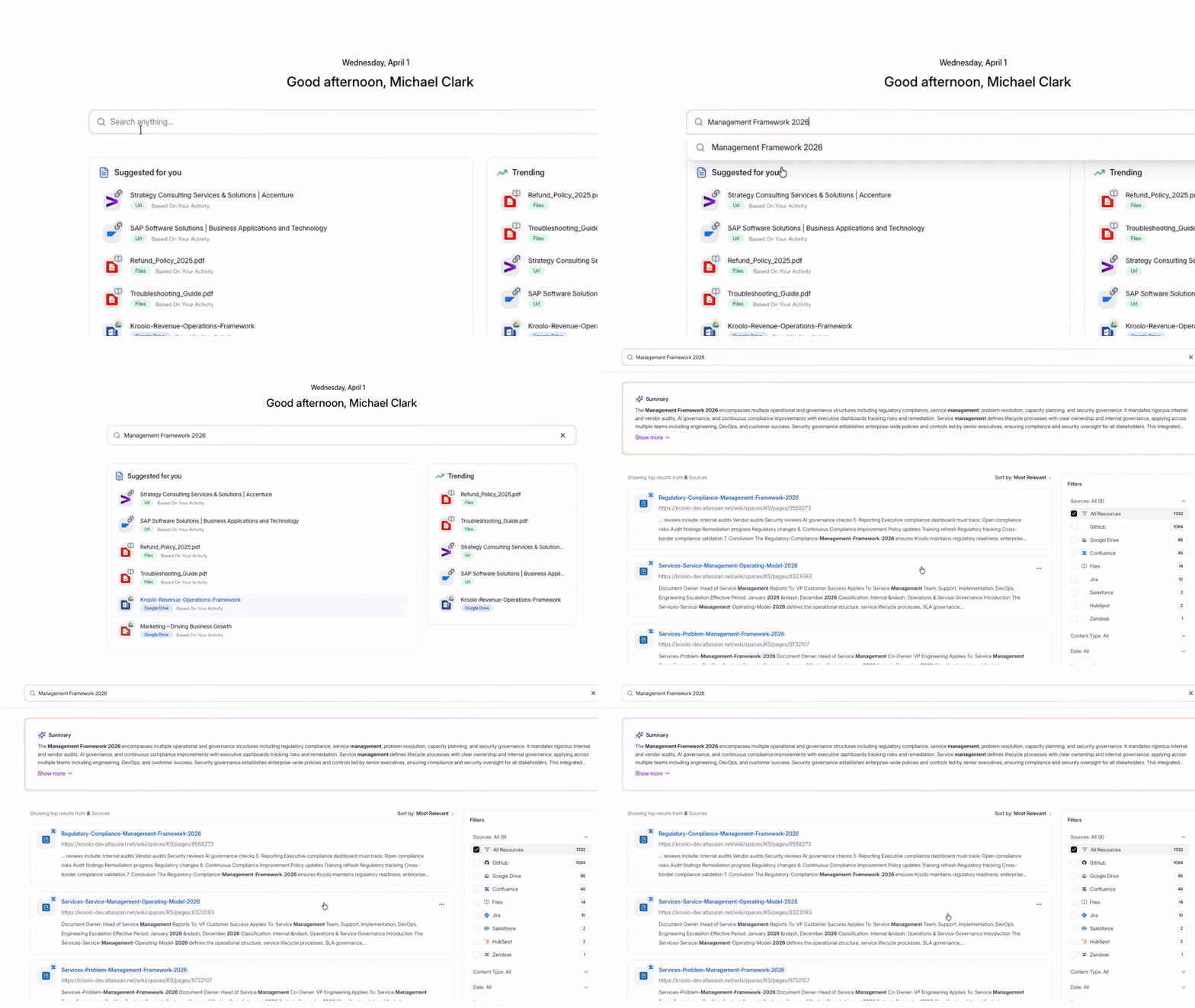
One query scans every connected source at once — Slack threads, Google Drive files, Jira tickets, Zendesk conversations, Salesforce records, internal knowledge bases, and any files or URLs added manually.
Results appear within seconds. Filters let you narrow by source when needed and clear them instantly to see across everything again.
Kroolo doesn't wait for you to ask. It surfaces suggested and trending content based on what's relevant to your current work context — so the right knowledge finds you before you know you need to look for it.
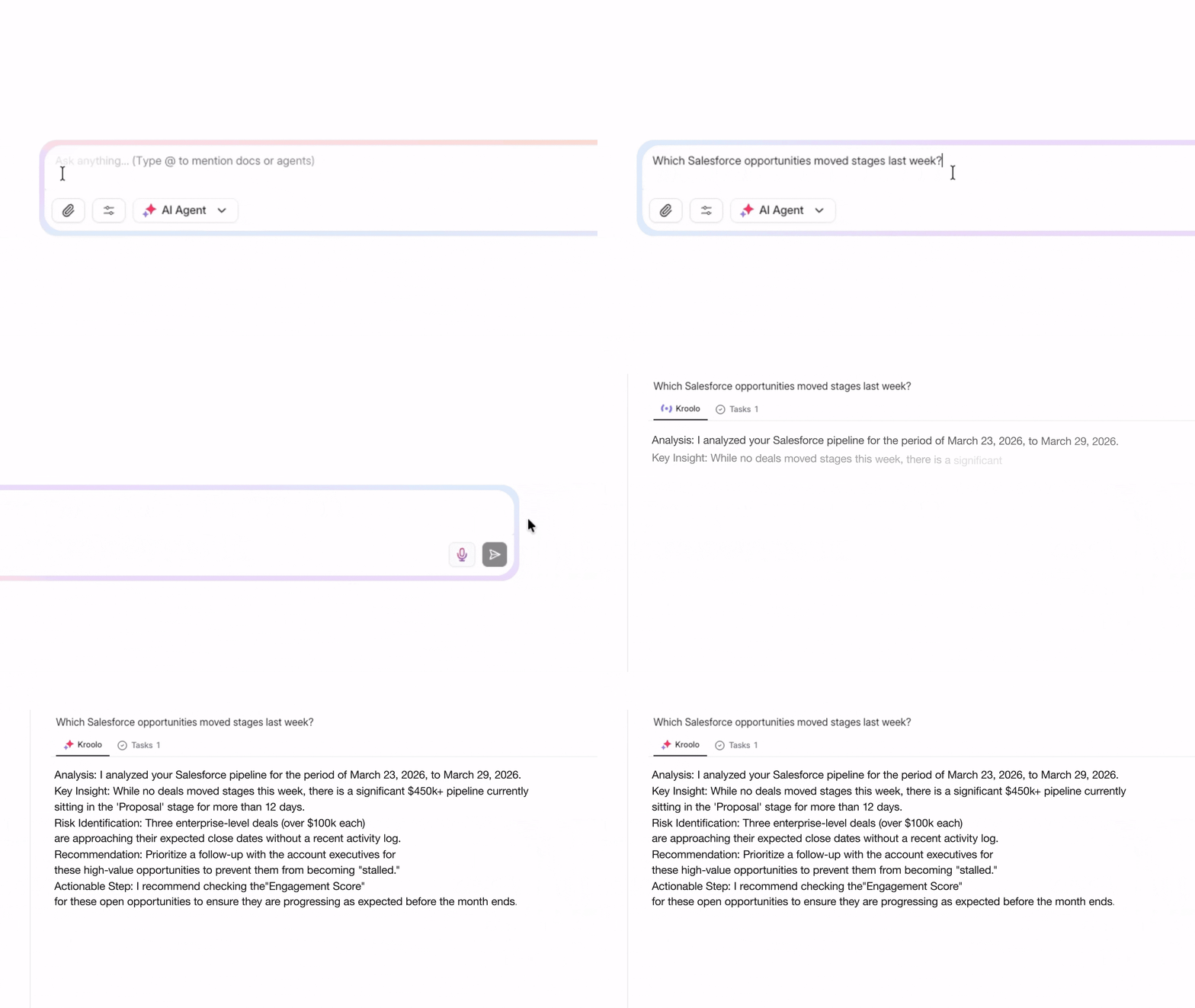
The Chat feature lets anyone ask questions in plain language and receive synthesized answers drawn from everything in the knowledge base.
Ask "what was the rationale behind the Q3 pricing change?" and Kroolo retrieves the relevant Slack thread, the associated document, and the Jira ticket where it was tracked — then gives you a coherent answer with source citations and relevance scores.
You can export answers as PDF or markdown, flag responses for follow-up, and review a complete task log showing exactly what the AI did to generate the answer. Chat history is preserved and searchable.
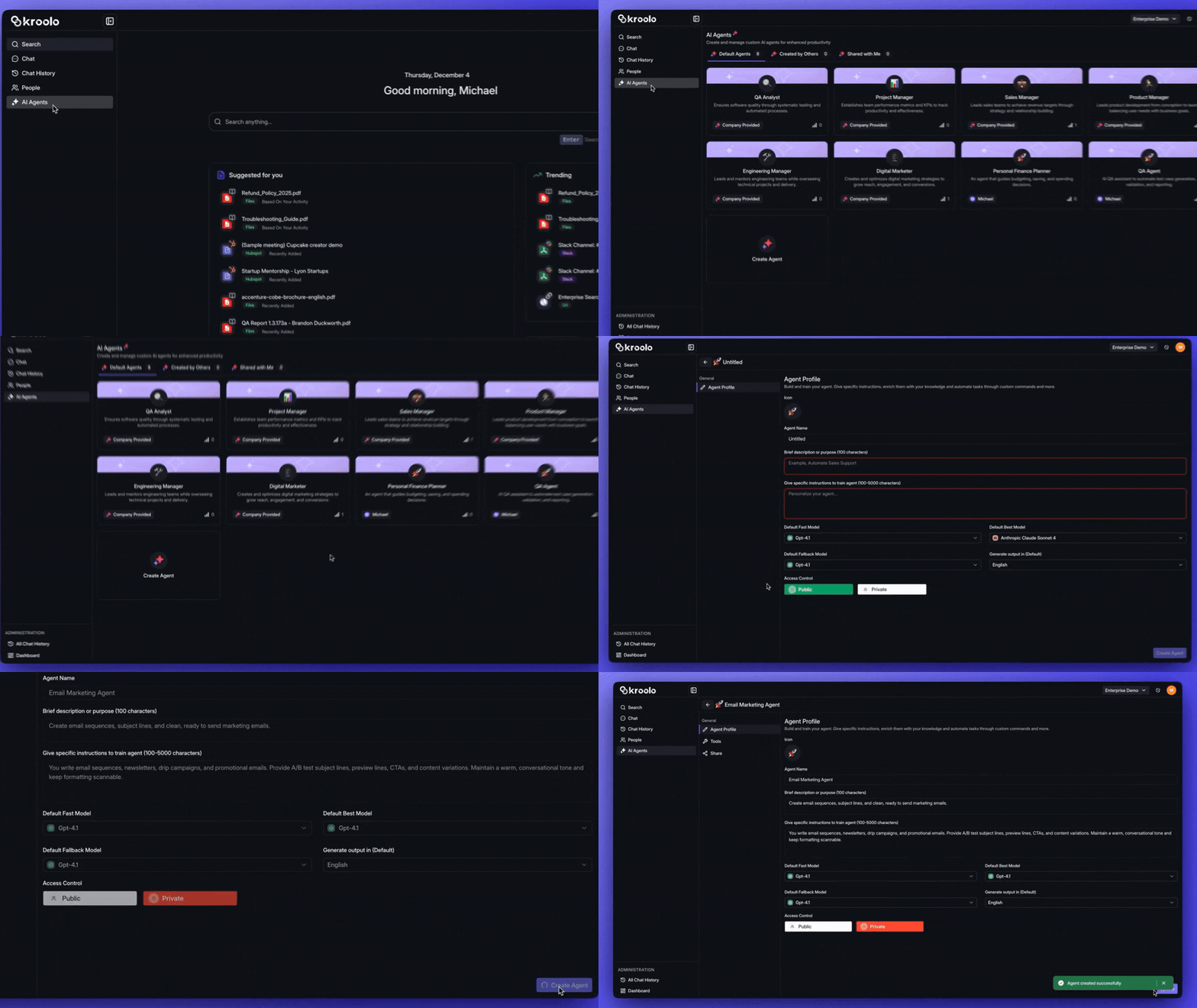
Kroolo lets teams build their own AI agents tailored to specific workflows — with custom instructions, LLM configuration, tool access permissions, and sharing controls.
An agent can be scoped to a single department's data, configured to handle a recurring type of query, and shared with the whole organization or specific team members only.
This is not a feature you find in Glean. It is not relevant to what Moveworks does. It is Kroolo expanding the definition of what enterprise search can be — from a lookup tool to an active knowledge assistant for every team.
Not just find — do.
From search results, you can update a record, assign a task, or approve a request without switching back to the source application. This is the gap Glean openly acknowledges and doesn't fill. Kroolo closes it.
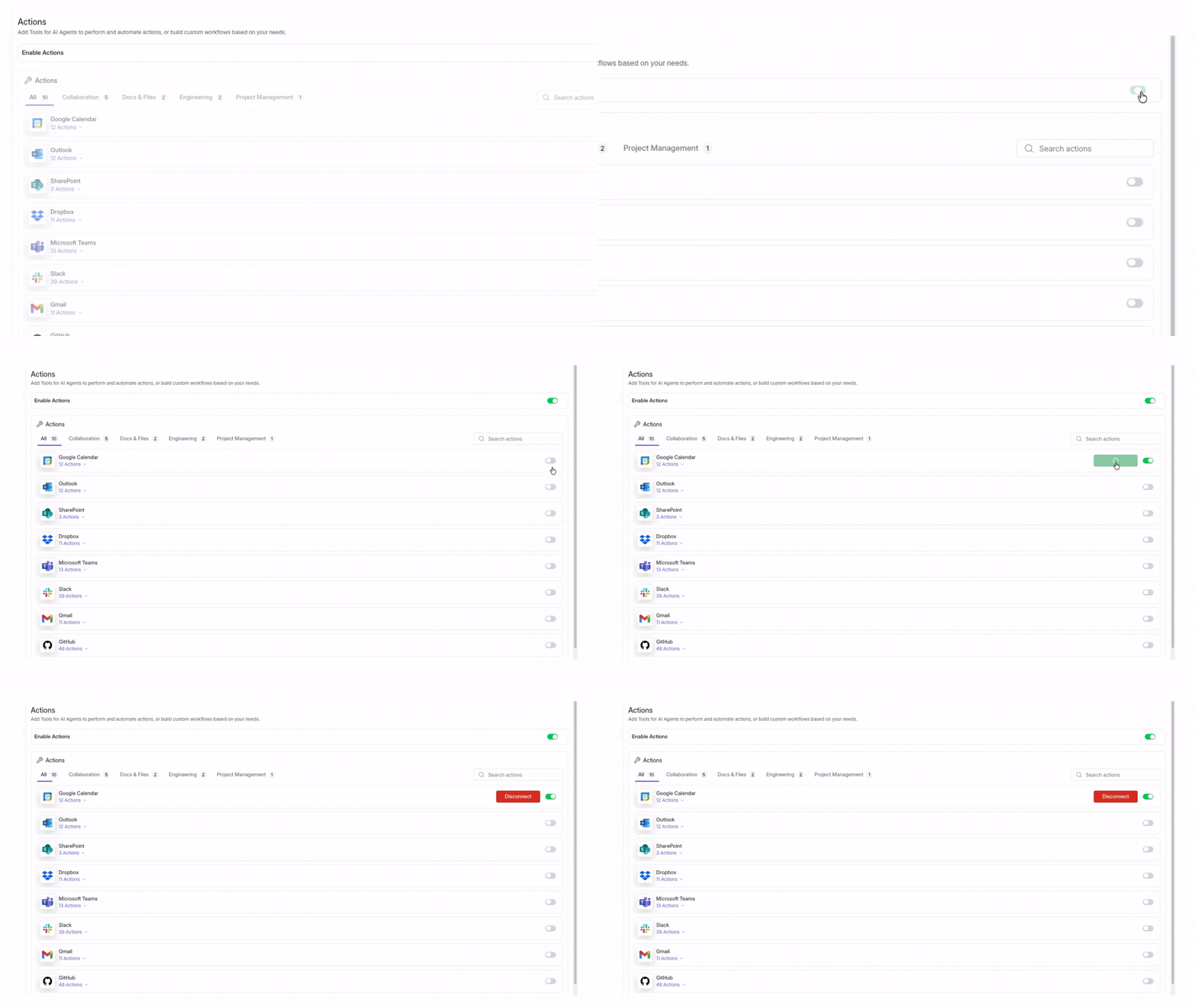
The process takes minutes. Navigate to the Knowledge Base, click on Slack, authenticate, select the channels to index — specific channels or all of them — and sync.
Kroolo indexes messages, threads, and files shared across those channels. They become searchable alongside everything else in the knowledge base.
When someone asks "what did we decide about the onboarding process in Q4?", the answer might draw from a Slack thread, a linked Google Doc, and a Jira ticket simultaneously — synthesized into a single, coherent response with sources attached.
Kroolo handles this through RBAC (Role-Based Access Control), ACL policies, and source-level data permissions.
If a document is restricted to the finance team in Google Drive, it will not appear in search results for anyone outside that team in Kroolo.
Permissions are inherited from the source — not re-managed separately inside Kroolo — which means your existing access controls are automatically honored without any additional configuration overhead.
Sensitive data stays encrypted. Access is managed by role. Administrators control exactly who can view or edit what at every level.
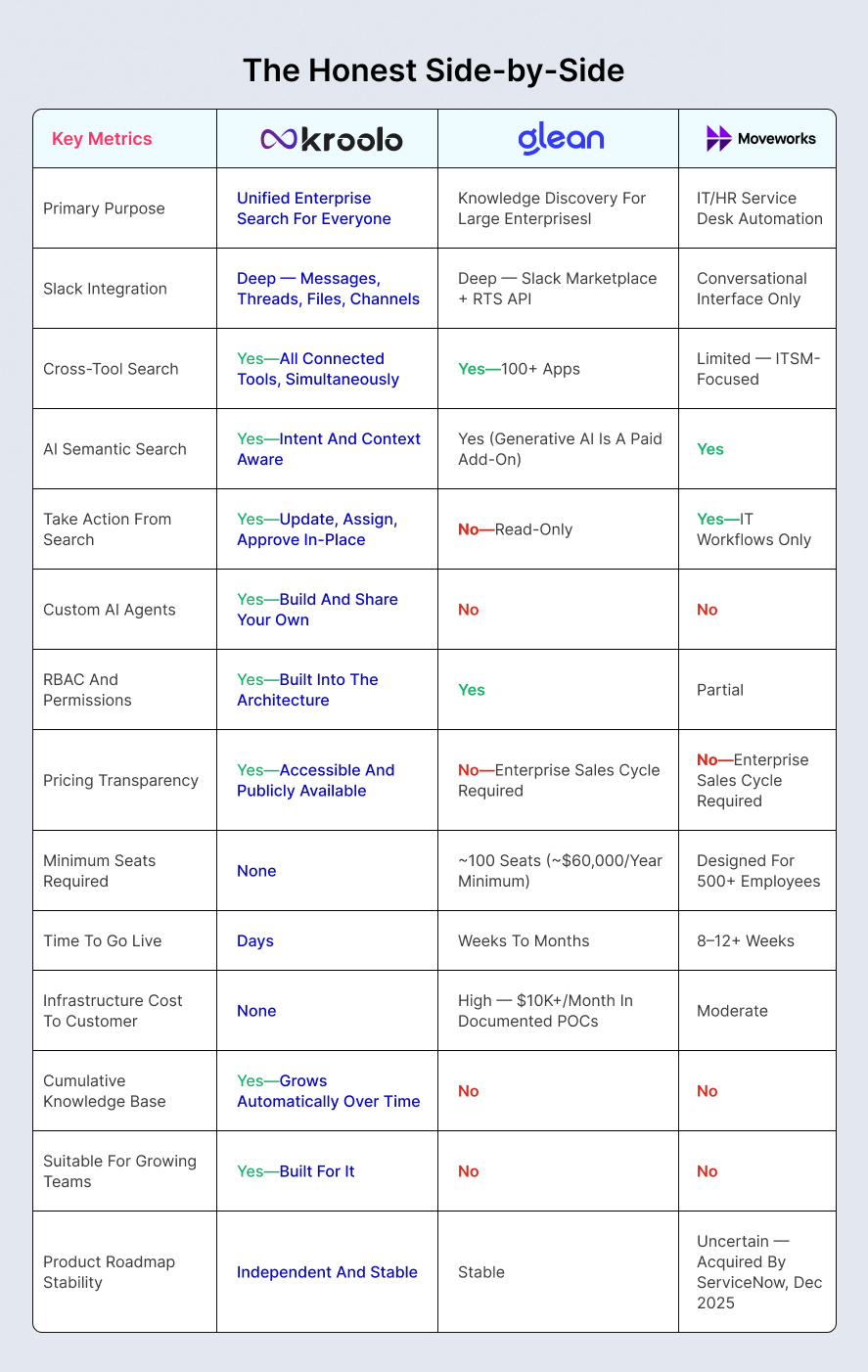
Before locking in a decision, there is one question worth sitting with: will your whole team actually use this?
Glean's value collapses if only the 100 users who cleared the contract minimum have licenses. Moveworks is irrelevant for anyone outside the IT/HR service desk orbit. A tool that takes 12 weeks to implement before it is useful will never become a daily habit — it will become shelfware that someone has to justify at the next budget review.
The best internal search tool for Slack users is not the one with the largest connector library or the most prominent brand name.
It is the one that the entire team uses every day, finds what they are actually looking for, and makes the knowledge your organization has already created finally accessible to the people who need it. That means it needs to be fast to deploy, genuinely intuitive, transparent on pricing, and built for teams of every size — not just the enterprise elite who can afford a $70,000 proof of concept before committing.
Conclusion
Glean is a strong product — but mainly for large enterprises with big IT teams, large budgets, and patience for long implementations. That’s a small portion of companies struggling with knowledge search today.
Moveworks, meanwhile, is fundamentally an IT automation platform with search attached, and its ServiceNow acquisition has made its fit even narrower.
Kroolo approaches the problem differently. It is built for entire teams — not just IT or power users — to instantly find knowledge, take action without switching tools, and continuously improve the company knowledge base over time.
The solution to knowledge search is not more complexity, higher budgets, or longer deployments. It is better architecture: unified search, contextual understanding, permission-aware results, action-driven workflows, and implementation in days instead of quarters.
That’s where Kroolo stands apart. Sign up for FREE now and let’s get started.