

Apr 15, 2026
-
By Ivan
ClickUp Is Killing Your Engineering Velocity.
ClickUp was not built for your dev team. It was built for marketing ops, and your engineers know it.
Every 3-second page load. Every ClickApp toggle is buried three menus deep. Every standup is actually just someone sharing their GitHub screen because the tickets in ClickUp don't match what's being shipped.
That's not a configuration problem. That's a product-market fit problem, and your team is on the wrong side of it.
If you're running high-velocity software development on ClickUp in 2026, you're paying a tax measured in engineer-hours, cycle time, and attrition.
The good news: there's a clean way out, and the top teams have already taken it.
The phrase gets thrown around until it's meaningless. Let's define it.
A high-velocity team ships multiple times a week, sometimes multiple times a day. Cycle time is measured in days, not weeks. Engineers open the issue tracker as often as their IDE. Sprint ceremonies are short because the tool does the bookkeeping. PRs close tickets automatically. When something breaks in production, the path from alert to triaged ticket to assigned engineer takes minutes.
If that sounds like your team, you need a tool built for that reality, not a Swiss Army knife that happens to have an agile board in it.
ClickUp isn't bad software. It's software optimized for a different buyer. That mismatch creates four specific costs your team is paying right now, whether or not anyone has put a number on them.
1. The latency tax
An engineer opens their task board roughly thirty times a day. If each load takes three seconds instead of under one, that's a minute and a half, every day, per engineer, spent watching a spinner.
On a ten-person team that's 65 hours a year of pure wait time. It sounds petty until you realize the real cost isn't the seconds, it's the habit: engineers stop checking the board.
2. The configuration tax
Want to turn on story points? That's a ClickApp. Want velocity tracking with those story points? You need the Sprints ClickApp too, with sprint durations, default statuses, and rollover rules configured at the space level.
What should be a toggle becomes a thirty-minute scavenger hunt through help docs. Multiply by every workflow decision. You've built a part-time ops job out of running your tool.
3. The onboarding tax
New engineers need two to three weeks to become productive in ClickUp. In Linear, it's a day. Over a year of hiring, that's weeks of paid ramp time lost to UI density, not product complexity.
4. The context-switching tax
Industry research cited by Zenhub pegs the average loss at 5.3 hours per engineer per week, bouncing between their PM tool and their actual work.
When the PM tool doesn't natively understand branches, PRs, and deployments, your team ends up maintaining two sources of truth and reconciling them by hand.
Add it up. On a team of ten engineers at a loaded cost of $150/hour, the context-switching tax alone is somewhere north of $400,000 a year. That's not a tooling decision. That's a line item.
None of this means ClickUp is a bad product. It means it's optimized for a different user than the engineer writing code on your team.
Before naming names, here's the rubric that actually matters for a dev-focused tool:

Kroolo isn't a lighter ClickUp. It's a different thesis about what a work platform should be in 2026.
ClickUp's thesis is "every feature, configurable." Kroolo's thesis is "every workflow, AI-native." Same all-in-one promise — projects, docs, goals, chat — but built on top of AI agents that do the project admin your engineers currently do by hand. That's not a marginal difference. That's the entire point.
Here's what that looks like in practice.
Drop an RFP, a PRD, or a scope doc into Kroolo, and its Project Agent generates a structured board with tasks, subtasks, and a suggested workload distribution in under a minute. No staring at an empty board wondering where to start.
No spending an afternoon breaking epics into tickets. The AI does the first pass; your PM edits. Kroolo claims a project board in 6 seconds and project imports in under 10 — the speed isn't a marketing line, it's what the product is designed around.
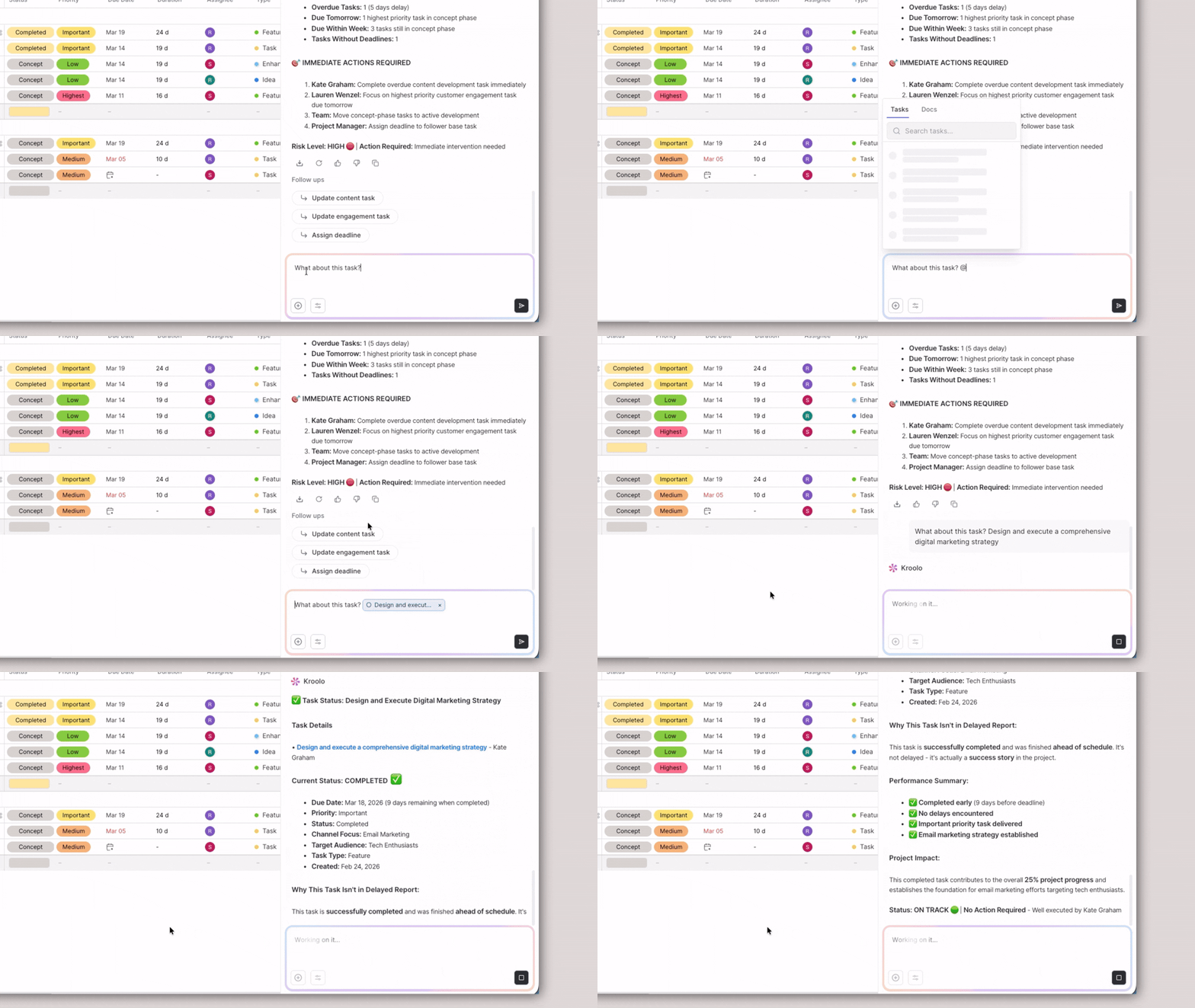
Ask Kroolo AI what's overdue, what's unassigned, what's at risk, and what shipped — get a synthesized answer instantly. That's 15 minutes a day per team you get back. Across a quarter, that's real engineering time.
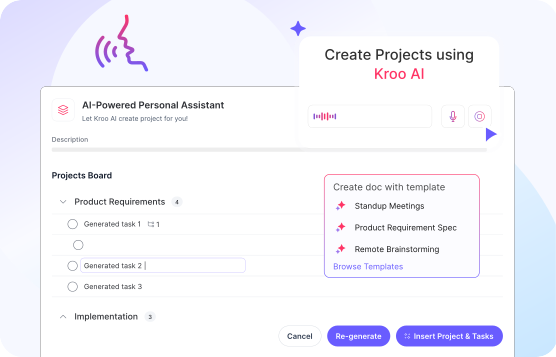
Kroo AI indexes your projects, docs, chats, and portfolio, which means it can reason across them. ClickUp Brain operates more like a chatbot on top of your tasks; Kroolo's agents act on the workspace. Different architectures, different outcomes — one summarizes, the other executes.
This is where the knife goes in. Kroolo's paid tiers start at $10/user/month (Plus) and $18/user/month (Business), with AI included. ClickUp Business is $12/user/month and the real AI capabilities sit behind ClickUp Brain as a paid add-on. By the time you've added AI, dashboards, and the integrations you need, ClickUp often costs more for less cohesion.
Kroolo's Integration Hub imports boards from ClickUp, Jira, Asana, Trello, Monday, and Basecamp in seconds. You're not rebuilding your workspace. You're moving it.
The table makes the real story obvious. ClickUp sells configurability. Kroolo sells outcomes. For an engineering team that just wants to ship, the second one wins.
|
Capability |
ClickUp |
Kroolo |
|
Set up the first productive board |
Hours to days of ClickApp configuration |
Under 60 seconds via AI from a brief or doc |
|
AI project generation |
Limited; via ClickUp Brain add-on |
Native; generates full boards from docs or voice prompts |
|
AI standups |
Manual |
Ask AI: overdue tasks, blockers, risks, unassigned work |
|
Automated subtask breakdown |
Manual or template-based |
AI-generated from parent task context |
|
Speed of core interactions |
Page loads commonly 2–3 seconds slower |
Project board creation in ~6 seconds, imports in ~5 |
|
Story points & velocity |
Requires enabling Sprints ClickApp + config |
Built in; velocity auto-calculates |
|
Multiple views |
List, Board, Gantt, Calendar, Timeline |
List, Kanban, Calendar, Timeline, Grid, Workload |
|
Docs |
Native, mature |
Native, AI-assisted drafting and chat with doc |
|
OKRs & goals |
Native, linked to tasks |
Native, AI-suggested goal-to-task alignment |
|
Onboarding time for new engineers |
2–3 weeks |
Under a day |
|
Migration from other tools |
Manual import, CSV-heavy |
Integration Hub: ClickUp, Jira, Asana, Trello, Monday imported in seconds |
|
Free plan |
Yes, limited |
Yes — 5 members, 5 projects, generative AI included |
|
Paid plans (per user/month) |
Business at $12; AI is a paid add-on |
Plus $10, Business $18 — AI included |
|
Tools replaced |
Marketing positioning: many |
Estimated to replace at least 3 existing tools in a typical stack |
Don't big-bang it. The playbook that works:
Start with one team, ideally a squad that's already frustrated with ClickUp. Use Kroolo's Integration Hub to import their active work only, not the historical archive.
Give them two weeks to live in Kroolo while ClickUp stays read-only.
Measure three things: cycle time, hours spent in standup and status reporting, and the number of tickets closed that actually map to shipped work. If the numbers move — they usually do — roll it out to the next team.
Most teams see the AI-generated project boards and the self-running standups land first. Those are the wins that turn skeptics into advocates inside a sprint.
Conclusion
ClickUp sells one tool that replaces them all. For the buyer in the exec suite, that pitch lands. For the engineer writing code at 2pm on a Tuesday, it's a tax on their focus.
Kroolo takes the same promise and rebuilds it around AI that actually does the work — generating projects, running standups, triaging tickets, surfacing risks — so your engineers go back to engineering. Same breadth, a fraction of the admin overhead, and pricing that doesn't punish you for needing AI.
The best tool isn't the one with the most features. It's the one your team uses at full speed without fighting it. For high-velocity software teams in 2026, that's Kroolo.
Sign up for Kroolo — Free Forever
No credit card. No seat limits to hit in week one. No waiting on a sales demo to see the product.
Spin up your first AI-generated project board in under 60 seconds and see what your team's been missing